
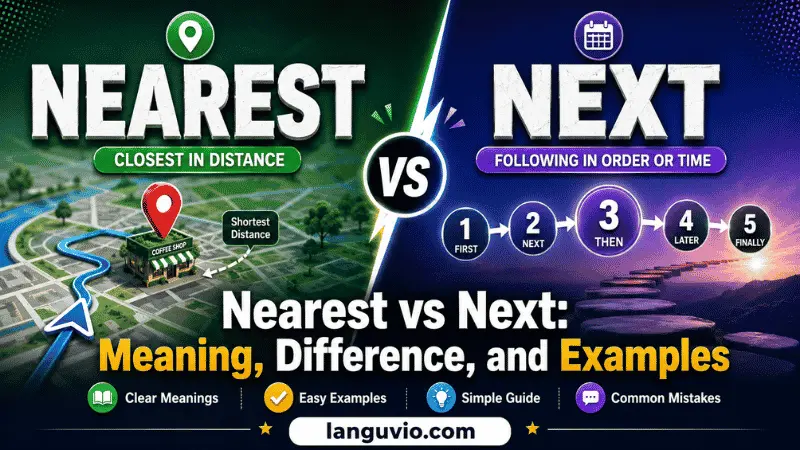
Both nearest and next are standard English words, but they answer different questions. Nearest usually identifies the person, place, thing, or point that is closest. Next identifies what comes immediately after the current or stated one in time, order, or sequence.
That difference matters in everyday directions. The nearest gas station is the closest one to you. The next gas station is the one you will reach after your current point on a route. Sometimes those are the same station, but the words still express different ideas.
Quick Answer
Use nearest when you mean closest. Use next when you mean the one that follows.
- Nearest: “Where is the nearest pharmacy?” You want the pharmacy with the shortest distance from your location.
- Next: “Turn right at the next intersection.” You mean the first intersection you reach after your current position.
Both words can relate to place and time, so “nearest = place” and “next = time” is too simple. The real contrast is proximity versus sequence.
Why People Confuse Them
The words overlap because something that comes next may also be physically close. If you are driving, the next exit is often the nearest upcoming exit. Likewise, the next room may be the room directly beside the one you are in.
The confusion grows because next to expresses adjacency, while nearest to compares distances. Context tells you whether you are choosing by closeness or by order.
Key Differences At A Glance
| Context | Best Choice | Why |
| Closest grocery store | nearest | Compares physical distance |
| First stop you will reach on a route | next | Follows your current position |
| Closest seat to the door | nearest | Selects the shortest distance |
| Person after you in line | next | Expresses sequence |
| Upcoming appointment in a schedule | next | Refers to the following event |
| Building directly beside another | next, usually in “next to” | Expresses adjacency |
Compact comparison:
- Nearest: closest by distance, time, degree, or another point of comparison.
- Next: immediately following in time, order, sequence, or position; it can also describe something adjacent.
Meaning and Usage Difference
Nearest is the superlative form of near in modern English. It selects the closest member of a group or the point with the least distance from a reference point: “the nearest clinic,” “the seat nearest the stage,” or “the date nearest the deadline.”
Next points forward in a sequence: “the next chapter,” “the next customer,” “next month,” or “what happened next?” It can also describe adjacent space, as in “the next room” or “the house next to ours.”
Grammatically, nearest commonly works as an adjective or adverb. Next has broader use and can work as an adjective, adverb, pronoun, or noun depending on the sentence.
Tone, Context, and Formality
Both words are neutral and standard in American English. Neither is inherently more formal.
Nearest sounds natural when location or measurable closeness matters. Maps, directions, emergency instructions, and comparisons often use it.
Next sounds natural when people are thinking about order, schedules, steps, turns, or what follows. It is also normal in spatial expressions such as next door, next room, and next to.
The key difference is meaning, not politeness or formality.
Which One Should You Use?
Ask one simple question: Am I choosing by closeness or by order?
Choose nearest for closeness: “Find the nearest parking garage.”
Choose next for order: “Use the next parking garage you see on this road.”
The distinction is especially useful with transportation. The nearest station may be the station physically closest to your location. The next station is the station that follows your current station on the route.
When One Choice Sounds Wrong
Use nearest only when a comparison of closeness makes sense. “My nearest meeting is Monday” sounds unnatural if you simply mean the meeting that follows your current one. “My next meeting is Monday” is the normal choice.
Use next carefully when the goal is shortest distance. “Where is the next hospital?” may suggest the hospital you will encounter later on a route, not the hospital closest to you. If you need the closest facility, ask for the nearest hospital.
Calendar phrases can also be unclear. If “next Friday” could cause confusion, give the actual date.
Common Mistakes (and Quick Fixes)
Mistake: “Where is the next ATM?” when you mean the closest ATM.
Fix: “Where is the nearest ATM?”
Mistake: “Who is the nearest person in line?” when you mean the person who follows.
Fix: “Who is the next person in line?”
Mistake: Treating next to and nearest to as identical.
Fix: Use next to for direct adjacency and nearest to when comparing which person or thing is closest.
Mistake: Assuming next can only refer to time.
Fix: Remember that it also works for order and adjacent position.
Everyday Examples
- The nearest urgent care center is about a mile away.
- We will get off at the next stop.
- Please sit in the chair nearest the window.
- The next customer can come to register three.
- Our next team meeting is on Thursday.
- She works in the next office.
- Which entrance is nearest to the parking lot?
- Take the next left after the bridge.
- The nearest available table was beside the patio door.
- I finished one assignment and started the next.
Each sentence depends on the same choice: closeness favors nearest; sequence or immediate following favors next.
Dictionary-Style Word Details
Verb
Nearest: Not used as a verb in standard American English. The related base word near can be a verb, but nearest itself is not a verb form.
Next: Not used as a verb in standard American English.
Noun
Nearest: Not commonly used as a standalone noun. In phrases such as “the nearest one,” it functions with an understood or stated noun.
Next: Can function as a noun meaning the person or thing that follows, as in “from one day to the next.”
Synonyms
Nearest: Closest plain alternative: closest. In distance comparisons, farthest can serve as a clear opposite.
Next: Depending on context, close alternatives include following, upcoming, and adjacent. In a sequence, previous is a useful opposite.
Example Sentences
Nearest: “We chose the nearest entrance because it was raining.”
Next: “The next bus leaves in twelve minutes.”
Nearest: “Her desk is nearest to the conference room.”
Next: “Read the next paragraph before answering.”
Word History
Nearest: Modern English treats nearest as the regular superlative of near.
Next: The word has an older connection with the idea of being closest. It developed from an Old English superlative related to nigh, but modern English mainly uses next for what follows or stands immediately adjacent.
Phrases Containing
Nearest: nearest to, nearest and dearest, nearest thing to.
Next: next to, next door, next in line, next time, next up.
These phrases show why the words can overlap in meaning without becoming interchangeable.
FAQs
Use nearest when you want the store closest to your current location. Use next when you mean the store you will encounter after your present point, such as while driving along a route. The two stores may happen to be the same.
Both can be correct, but they answer different questions. The nearest station is physically closest to you. The next station is the following stop in a route or sequence. A transit rider and a person searching a map may therefore choose differently.
Yes. The closest location may also be the first location you reach next. For example, the nearest gas station could also be the next gas station on your highway route. Even then, nearest highlights distance while next highlights order.
No. Next to usually means directly beside something, often with nothing significant between. Nearest to identifies whichever person or thing is closest among the available choices. Someone can be nearest to a window without sitting directly beside it.
Yes. Nearest can describe closeness in time when several times or dates are being compared. Still, everyday schedules usually favor next for the event that follows, as in “my next appointment.” Choose the word that matches comparison or sequence.
Because next can express adjacent position as well as sequence. “The next room” commonly means the adjoining or immediately neighboring room, while “next to the house” means beside it. This spatial use does not change the broader distinction between following and closest.
Conclusion
The safest way to choose between nearest and next is to identify the relationship you mean. Use nearest for what is closest. Use next for what immediately follows in a sequence, schedule, route, or position.
Remember the station example: the nearest station is closest to you, while the next station is the following stop. Once you separate proximity from sequence, the difference becomes much easier to apply.


