
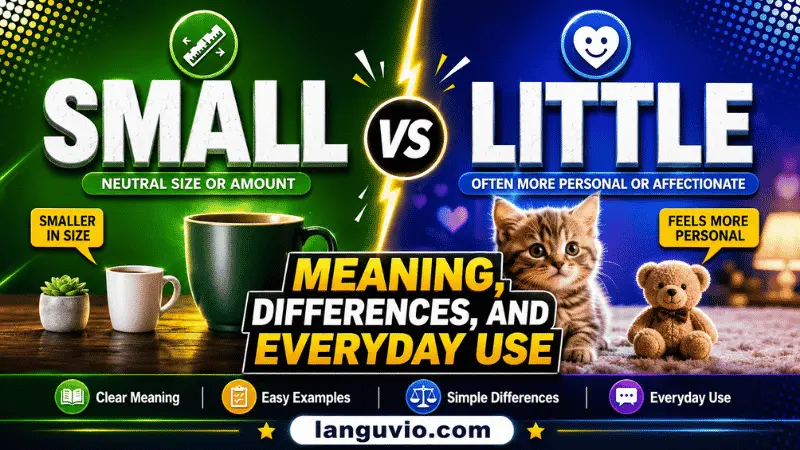
Small and little are both correct English words, and sometimes either one works. The difference is that they do more than simply describe the same kind of size.
Small usually gives a neutral description of size, scale, number, or extent. Little can also mean small in size, but it has several additional jobs. It can refer to a limited amount, a slight degree, a young person, or even express affection, annoyance, or dismissal.
That is why changing one word to the other sometimes leaves a sentence unchanged and sometimes changes its meaning completely.
Quick Answer
Use small when you want a clear, neutral description of physical size or scale: a small apartment, a small screen, a small company.
Use little when size comes with another idea, such as affection, youth, a limited amount, or a slight degree: a cute little dog, a little child, little time, a little nervous. Both can describe size, but little has a wider range of grammatical and emotional uses.
Why People Confuse Them
The confusion starts because small and little genuinely overlap.
You can describe a dog as small or little. A house can be small or little. Merriam-Webster treats the words as near-synonyms in their size meanings and notes that they are often interchangeable.
The problem appears when learners assume that this overlap applies everywhere.
Compare:
- a small dog — mainly describes its size
- a little dog — describes its size and may sound warmer or more affectionate
- a little water — means a limited amount of water
- a small water — does not normally express that meaning
- a little nervous — means slightly nervous
- a small nervous — is not standard phrasing
So the words overlap in one part of their meaning, but their full grammatical ranges are different.
Key Differences At A Glance
- Small: usually neutral and factual when describing size, dimensions, number, scale, or extent.
- Little: can describe small size but may also suggest affection, youth, insignificance, criticism, or another attitude.
- Small: works naturally in comparisons such as smaller and smallest.
- Little: also has comparative forms in some size meanings, but less and least serve many of its amount and degree meanings.
- Little: can express quantity with uncountable nouns: little money, a little time.
- A little: can modify an adjective or adverb: a little tired, a little faster.
- Small: cannot normally replace a little in those quantity or degree structures.
Meaning and Usage Difference
The most common use of small is as an adjective describing something below the usual or expected size.
The kitchen is small.
Here, the sentence makes a straightforward statement about size.
Little can perform the same basic job before many nouns:
They bought a little house near the lake.
However, little can add a more personal feeling. The speaker may see the house as charming, cozy, modest, or otherwise noteworthy because of its size. Cambridge and Collins both distinguish this emotional use from a purely factual size description.
Little also goes beyond physical size.
We have little time left.
Here, little means not much.
We have a little time left.
Here, a little means some time, though not much.
It can also show degree:
I’m a little worried.
In that sentence, a little means slightly. Small cannot take over that function.
Tone, Context, and Formality
Small is often the more neutral choice when a writer simply wants to report a fact.
The company operates from a small office.
Nothing in that sentence necessarily suggests affection or criticism.
Little can be more expressive.
They have a lovely little office downtown.
The sentence now feels more personal.
That emotional coloring can also be negative:
That was a nasty little comment.
The physical-size meaning has almost disappeared. Little helps make the comment sound petty or contemptible.
Collins describes little as slightly more informal than small in its ordinary size use, but this is not a rule that makes little unsuitable for standard writing. Both are standard words. Context and intended meaning matter more than a simple formal-versus-informal label.
Which One Should You Use?
Use the intended meaning as your guide.
| Context | Best Choice | Why |
| Neutral physical size | small | Gives a straightforward size description |
| Affectionate size description | little | Can add warmth or endearment |
| Young child | little | Can refer to youth as well as size |
| Limited uncountable quantity | little / a little | Functions as a quantity expression |
| Slight degree before an adjective | a little | Means “slightly” |
| Direct physical comparison | smaller | Natural comparative of small |
| Fixed expression | depends | Established combinations control the choice |
These are practical tendencies rather than a claim that every noun follows a mechanical rule. Dictionaries and collocation references show substantial overlap alongside established restrictions.
When One Choice Sounds Wrong
Some structures clearly favor one word.
Amount
I have little money left.
Using small money would not mean the same thing. You could instead say a small amount of money.
Degree
I’m a little tired.
Not:
I’m a small tired.
Family relationships
He’s my little brother.
This commonly means he is the younger brother.
He’s my small brother.
This would normally describe his physical size rather than his place in the family. Merriam-Webster specifically records the younger-sibling meaning of little.
Fixed combinations matter as well. Oxford’s collocations guide gives small fortune as an example of a phrase where replacing small with little does not preserve the same established expression.
Common Mistakes (and Quick Fixes)
Mistake: “I need small help.”
Better: “I need a little help.”
Here, you mean a limited amount of help.
Mistake: “The new phone is more little.”
Better: “The new phone is smaller.”
For a straightforward physical comparison, smaller is natural.
Mistake: “I’m small worried about the test.”
Better: “I’m a little worried about the test.”
A little modifies the adjective worried and means slightly.
Mistake: Assuming little always means quantity.
Better: Remember that little can also describe size.
She carried a little bag.
That sentence can be completely natural.
Mistake: Assuming small and little can always trade places.
Better: Check the meaning and the whole phrase. English collocations sometimes prefer one even when the dictionary meanings overlap.
Everyday Examples
Neutral size
We rented a small apartment near campus.
The focus is physical size.
Warmer description
They found a charming little apartment near campus.
The speaker adds attitude as well as size.
Quantity
I have a little coffee left if you want some.
The phrase refers to an amount.
Limited quantity
We have little coffee left, so I’ll buy more.
Now the emphasis is that the remaining amount is low.
Degree
The second assignment was a little harder.
A little means slightly.
Youth
A little child was waiting with his parents.
Little can emphasize that the child is young.
Comparison
This backpack is smaller than mine.
Smaller gives the straightforward comparison of physical size.
Dictionary-Style Word Details
Verb
- small: Not commonly used as a verb in standard modern US English. Major current dictionary treatment centers on adjective, adverb, and noun uses.
- little: Not commonly used as a verb in standard modern US English. Modern major dictionary entries primarily treat it as an adjective, adverb, pronoun, and noun.
Noun
- small: Has limited noun uses. Examples include the small of the back and a size category such as a small when ordering or selecting something.
- little: Can function as a noun referring to a small amount, short time, or limited quantity, especially in expressions such as a little.
Synonyms
For the physical-size meanings:
- small: closest plain alternatives include little, tiny, and miniature, depending on context.
- little: closest plain alternatives include small and tiny when physical size is intended.
Common opposites for the size meaning include big and large, although individual phrases may favor one particular opposite or collocation.
Example Sentences
Small
The restaurant has a small dining room.
She chose the smaller suitcase.
Only a small group attended the morning session.
Little
A little dog followed us down the sidewalk.
I have a little time before my meeting.
He seemed a little uncomfortable during the interview.
These examples show why the comparison cannot be reduced to size alone: little can participate in size, quantity, and degree structures.
Word History
Small comes through Middle English from Old English smæl. Its older meanings included ideas such as narrowness, slenderness, or fineness as well as reduced size.
Little comes through Middle English littel from Old English lȳtel. Both words therefore have deep roots in English rather than one being a modern substitute for the other.
The history is useful mainly because it confirms that these are long-established near-synonyms with their own developed usage patterns; it does not give readers a simple modern rule for every sentence.
Phrases Containing
Small
- small talk
- small business
- small change
- a small fortune
- the small of the back
Little
- a little
- little by little
- little wonder
- a little while
- a little bit
Phrase-level usage matters because established combinations are not freely interchangeable. Small fortune, for example, is a conventional collocation that cannot automatically be replaced by little fortune while keeping the same intended expression.
FAQs
Sometimes, but not always. Both can describe reduced size, as in “a small dog” and “a little dog.” However, little can add affection, criticism, youth, quantity, or degree, so replacing it with small may change the meaning or tone.
Small is generally more neutral and can sound slightly more formal in factual descriptions. Little often feels more conversational when it adds warmth, attitude, or emphasis. Both words are standard English, so context matters more than a simple formal-versus-informal rule.
Both are correct, but they can suggest different things. A small child usually points to physical size. A little child often suggests youth and may sound warmer or more protective. Choose the phrase that matches the meaning you want.
Not when you mean “not much.” With uncountable nouns, little often works as a quantity word: “little time” or “a little water.” Small can appear before a countable unit, such as “a small amount of water” or “a small cup of coffee.”
Because a little can function adverbially to mean “slightly.” Small does not normally work that way before an adjective. Say “a little tired,” “a little worried,” or “a little late,” not “a small tired” or “a small worried.”
Small is usually the safer neutral choice when you are simply reporting size. Use it for descriptions such as “a small apartment,” “a small screen,” or “a small package.” Choose little when you intentionally want added feeling, youth, quantity, or degree.
Conclusion
The easiest way to handle small vs little is to start with meaning rather than memorizing an absolute rule.
Choose small for a neutral description of physical size or scale. Choose little when you need one of its broader uses: an affectionate or dismissive attitude, youth, a limited amount, or a slight degree.
When both describe physical size, either may sometimes be correct. Even then, the tone can change. And when a familiar expression strongly prefers one word, follow the established phrase rather than replacing it simply because the dictionary meanings look similar.


