
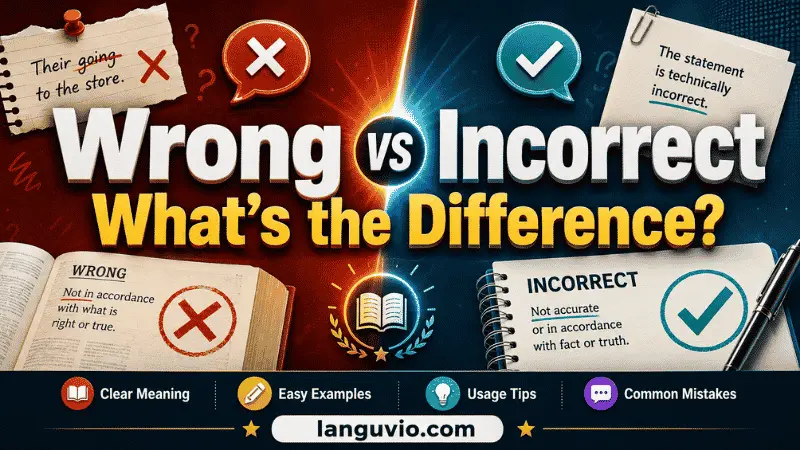
Wrong and incorrect can both describe something that is not correct. That is why sentences such as “Your answer is wrong” and “Your answer is incorrect” can communicate essentially the same factual judgment. Major dictionaries recognize this overlap directly.
The difference appears when you move beyond simple factual errors. Wrong is much broader. It can describe immoral behavior, an unsuitable choice, a mistaken direction, a malfunction, or a person whose belief is mistaken. It can also function as an adjective, adverb, noun, and verb. Incorrect is primarily an adjective describing something that fails to match a fact, standard, form, or appropriate requirement.
Quick Answer
Both wrong and incorrect are correct when you mean “not correct.”
Use incorrect when you want to focus clearly on an error in information, an answer, a calculation, grammar, spelling, or another standard. It often has a more formal or impersonal feel.
Use wrong for the same kinds of errors in everyday English, but also use it for moral judgments, unsuitable choices, directions, problems, and things that are not working properly.
So:
- “The answer is wrong.” — correct.
- “The answer is incorrect.” — correct.
- “It is wrong to steal.” — natural.
- “Something is wrong with my laptop.” — natural.
- “Something is incorrect with my laptop.” — normally unnatural.
Why People Confuse Them
The confusion comes from a large area of shared meaning.
If a statement does not match the facts, it may be wrong or incorrect. If a student chooses the wrong answer on a test, the teacher can also mark that answer incorrect. The same overlap applies to many calculations, claims, spellings, assumptions, and pieces of information.
Because the words overlap so strongly in these situations, learners may assume they are complete synonyms. They are not.
The key difference is range. Incorrect stays close to the idea of failing to meet correctness, accuracy, or an appropriate standard. Wrong reaches far beyond that idea.
Key Differences At A Glance
- Factual errors: Both words often work.
- Formality: Incorrect often sounds more formal or impersonal.
- Everyday speech: Wrong is highly natural and flexible.
- Moral judgment: Wrong is the normal choice.
- Malfunction or trouble: Use wrong, especially in “something is wrong.”
- Grammar: Incorrect is primarily an adjective; wrong has adjective, adverb, noun, and verb uses.
- Direct personal correction: “You are wrong” is common but may sound stronger than focusing on an incorrect statement or answer.
Meaning and Usage Difference
At their shared core, the two words can indicate a departure from truth or correctness.
The total is wrong.
The total is incorrect.
Both sentences work. Neither automatically implies dishonesty or moral failure.
However, wrong has several established meanings that incorrect cannot freely replace. Someone can take the wrong road, wear the wrong clothes for an occasion, make the wrong choice, or feel that something is wrong with the engine. Dictionaries also use wrong for conduct that violates moral, legal, or ethical standards.
Incorrect has a narrower center of gravity. It commonly describes answers, facts, statements, transcriptions, grammar, spelling, information, or procedures that do not meet the relevant standard. It can also mean improper or inappropriate, so saying it refers only to factual mistakes would be too restrictive.
Tone, Context, and Formality
Incorrect often sounds more formal and detached. That makes it useful when the speaker wants to focus attention on information rather than directly confronting a person.
Compare:
You are wrong about the deadline.
The deadline in your message is incorrect.
The first directly evaluates the person’s belief. The second evaluates a specific piece of information. That difference can make the second version feel less personal, although politeness ultimately depends on the entire sentence and situation. Learner discussions and dictionary-based explanations consistently note this practical register difference without making it an absolute rule.
Wrong itself is not rude. “That’s the wrong address” is ordinary neutral English. The sharper effect appears mainly when the word directly challenges a person: “You’re wrong.”
Which One Should You Use?
| Context | Best Choice | Why |
| Casual factual correction | Wrong | Short and natural in everyday English |
| Formal factual correction | Incorrect | Often sounds more neutral and precise |
| Test answer | Either | Both standard forms describe an error |
| Moral judgment | Wrong | Standard word for morally unacceptable conduct |
| Machine or general problem | Wrong | “Something is wrong” is idiomatic |
| Unsuitable choice | Wrong | Naturally covers the unintended or unsuitable option |
| Grammar or spelling error | Either | Both can identify a form that does not meet the standard |
| Formal data or report error | Incorrect | Keeps attention on accuracy rather than the person |
These are usage tendencies rather than rigid grammatical rules. In the large shared factual-error area, both choices may be completely natural.
When One Choice Sounds Wrong
Some substitutions technically suggest a related idea but do not sound natural in ordinary American English.
Natural: Something is wrong with the printer.
Unnatural: Something is incorrect with the printer.
Here, wrong means that a problem exists. Incorrect does not normally fill that construction.
Another clear case involves morality:
Natural: It was wrong to cheat.
Awkward for the intended moral judgment: It was incorrect to cheat.
Incorrect can carry a sense of improper behavior, but wrong is the established everyday word for a direct moral judgment.
The difference also appears with people:
Natural: I was wrong about the date.
A speaker normally would not say “I was incorrect about the date” as readily in casual conversation, although formal contexts can support constructions describing someone as incorrect. More often, incorrect modifies the person’s statement, belief, assumption, or answer.
Common Mistakes (and Quick Fixes)
Mistake: “Wrong always means morally bad.”
Fix: Wrong commonly means simply not correct.
I entered the wrong password.
No moral meaning is present.
Mistake: “Incorrect only describes factual information.”
Fix: Dictionaries also record senses involving something improper, unsuitable, or inappropriate.
Mistake: “Incorrect is always more polite.”
Fix: It can sound less personal, but wording matters more than one vocabulary choice.
Your figures are incorrect.
may sound neutral, while
Everything you wrote is completely incorrect.
can still sound severe.
Mistake: “Use incorrect in writing and wrong in speech.”
Fix: Both appear in speech and writing. The choice depends on meaning and register, not simply the communication medium.
Everyday Examples
At school:
I got two questions wrong.
The teacher marked two answers incorrect.
At work:
The invoice contains an incorrect total.
We sent the package to the wrong address.
In conversation:
I thought the movie started at seven, but I was wrong.
With a problem:
Something is wrong with the air conditioner.
With morality:
She believed it was wrong to take credit for someone else’s work.
With suitability:
We chose the wrong size for the room.
These examples show why memorizing “formal versus informal” alone is not enough. Meaning comes first; tone helps you choose when both words fit.
Dictionary-Style Word Details
Verb
- Wrong: Yes. As a verb, to wrong someone means to treat that person unjustly, unfairly, or harmfully. This meaning is different from merely making an incorrect statement.
- Incorrect: Not commonly used as a verb in standard US English. It functions primarily as an adjective.
Noun
- Wrong: Yes. A wrong can be an unjust, immoral, or injurious act. English also uses expressions such as “in the wrong” and “right a wrong.”
- Incorrect: Not normally a noun. The related noun is incorrectness.
Synonyms
For the shared factual meaning:
- Wrong: incorrect, mistaken, inaccurate, erroneous.
- Incorrect: wrong, mistaken, erroneous, inaccurate.
For moral wrong, closer alternatives can include immoral, unjust, or improper, depending on the sentence.
Useful opposites include right for many senses of wrong and correct for incorrect. The exact opposite depends on the intended meaning.
Example Sentences
Wrong:
We turned onto the wrong street.
I was wrong about her arrival time.
The company apologized to employees it had wronged.
Incorrect:
The application contained an incorrect phone number.
His calculation was incorrect.
The form was rejected because several entries were incorrect.
Word History
Wrong has Germanic roots and is connected historically with an older sense involving something crooked or twisted. Its noun and verb uses developed long ago alongside meanings involving injustice and error.
Incorrect entered English from forms ultimately based on Latin incorrectus, meaning “not corrected.” Historical evidence places it in English by the 15th century, with its modern factual-error sense developing later.
Phrases Containing
Wrong appears in many established expressions:
- go wrong
- get something wrong
- be in the wrong
- do someone wrong
- right a wrong
- take the wrong way
Because the word has such a broad grammatical and semantic range, it appears naturally in many fixed constructions.
Incorrect has fewer fixed idiomatic expressions. It more often forms ordinary adjective phrases such as:
- incorrect answer
- incorrect information
- incorrect assumption
- incorrect spelling
- incorrect calculation
- incorrect procedure
FAQs
They are interchangeable when you mean “not correct,” especially for answers, facts, calculations, or statements. However, wrong has several extra meanings. It can describe immoral behavior, a bad choice, a malfunction, or an unsuitable option, where incorrect may sound awkward.
Incorrect often sounds more neutral and less personal, especially in school, workplace, or professional feedback. “That figure is incorrect” focuses on the information. “You are wrong” directly labels the person’s judgment, so it can sound sharper even when the meaning is factual.
Both are standard. “Wrong answer” is very natural in everyday conversation, while “incorrect answer” often sounds more formal or evaluative. A teacher, test, or written report may use incorrect, but there is no grammar rule requiring one over the other.
It can sometimes mean improper or inappropriate, but it is not the usual choice for a clear moral judgment. “It is wrong to steal” sounds natural and direct. By contrast, “It is incorrect to steal” sounds detached and may suggest a rule or factual standard rather than a moral judgment.
“Something is wrong” is an established way to say that a problem exists or something is not functioning as expected. Incorrect normally identifies an error against a fact, form, or standard, so “something is incorrect with my phone” is not idiomatic.
Wrong can directly describe a person’s belief or judgment, as in “You were wrong about the date.” Incorrect is less natural as a direct description of a person. It usually modifies the person’s statement, answer, assumption, calculation, or other specific item.
Conclusion
The easiest reliable distinction is this: wrong and incorrect overlap when something is not correct, but wrong has a much broader range.
Choose incorrect when you want a relatively formal or focused way to identify an error in facts, information, form, or standards. Choose wrong freely for those same factual mistakes in ordinary English and whenever you mean immoral, unsuitable, mistaken, malfunctioning, or otherwise not as intended.
Do not turn that difference into an absolute rule. A wrong answer and an incorrect answer are both perfectly standard. The surrounding meaning tells you which word fits best.


