
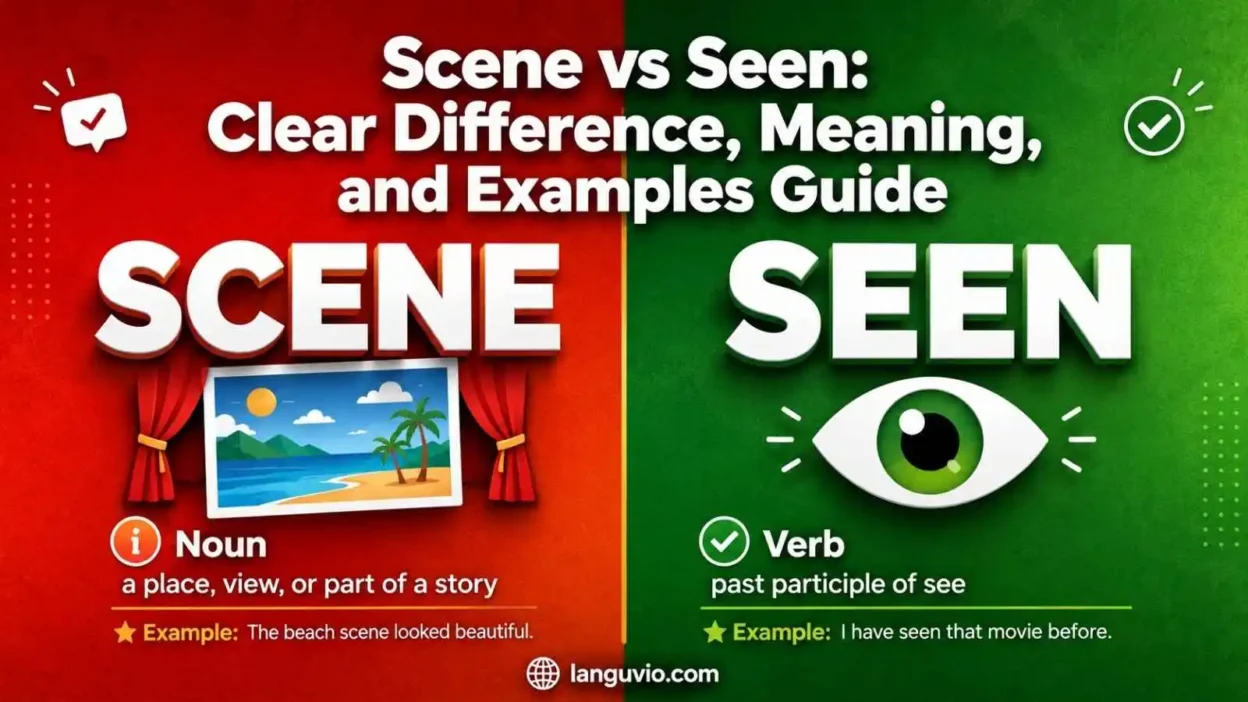
Scene and seen sound exactly alike, but they do not mean the same thing. Because of that, many writers mix them up in emails, schoolwork, captions, and everyday messages.
The difference is simple. Scene is usually a noun, while seen is a verb form.
In other words, use scene when you mean a place, setting, view, public incident, or part of a movie, show, play, or book. However, use seen when you mean that someone has viewed, noticed, or experienced something.
Quick Answer
Scene means a place, setting, view, event, or part of a story.
Example: The final scene made everyone quiet.
Example: Police arrived at the scene of the crash.
On the other hand, seen is the past participle of see. It usually appears with have, has, or had.
Example: I have seen that movie twice.
Example: She had never seen snow before.
A common mistake is writing I seen it. In standard American English, write I saw it or I have seen it instead.
Why People Confuse Them
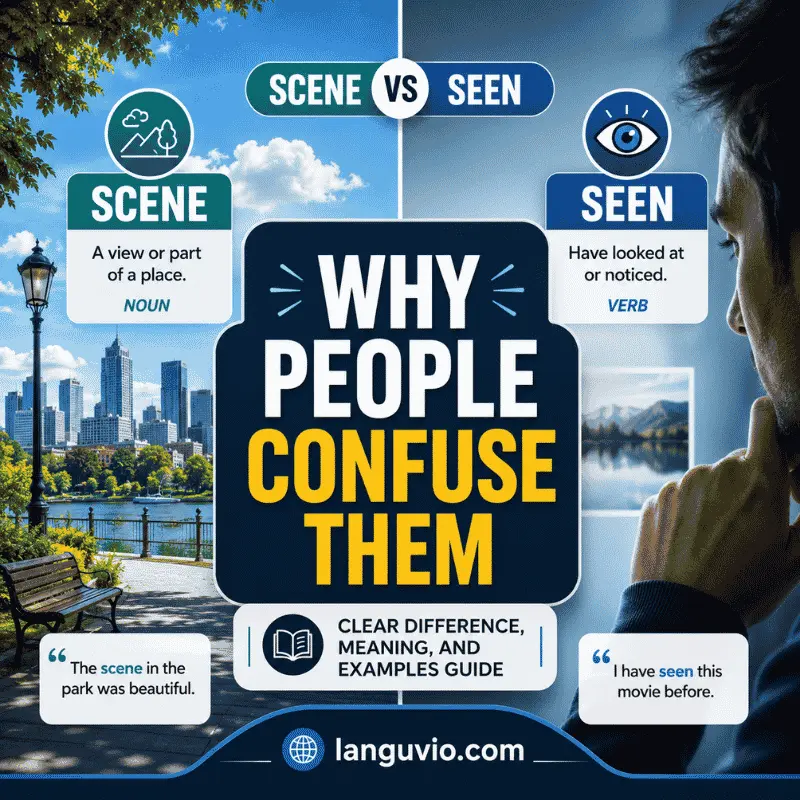
People confuse scene and seen mainly because they are homophones. That means they sound the same but have different meanings and spellings.
In conversation, this confusion is usually not a problem because context helps the listener. In writing, however, the spelling changes the meaning of the sentence.
For example, the final scene means the last part of a movie, show, play, or story. By contrast, I have seen it means you have watched, noticed, or experienced something.
So, the easiest way to avoid the mistake is to check the job of the word. If the sentence needs a thing or place, choose scene. If it needs a form of the verb see, choose seen.
Key Differences At A Glance
| Context | Best Choice | Why |
| A movie, play, show, or book part | scene | It names a part of a story or performance. |
| A place where something happened | scene | It names a location or setting. |
| Something viewed before | seen | It is the past participle of see. |
| After have, has, or had | seen | Perfect verb forms use seen, not scene. |
| After the, a, this, or that as a thing | scene | A scene is a noun. |
| Simple past with no helping verb | saw | Standard English uses saw, not seen. |
Here is the short version:
- Scene is a noun.
- Seen is a verb form.
- Scene can mean a place, view, setting, public incident, or story part.
- Seen means viewed, noticed, watched, or experienced.
- Scene often follows words like a, the, this, or that.
- Seen often follows have, has, or had.
Meaning and Usage Difference

Scene names something. Most often, it refers to a place where something happens.
Example: The reporter stood near the scene of the fire.
It can also mean part of a movie, show, play, book, or story.
Example: The opening scene takes place in Chicago.
In addition, scene can describe a view or setting.
Example: The mountain scene looked peaceful after sunrise.
Another common use is make a scene, which means to create a loud or embarrassing public situation.
Example: Please do not make a scene in the restaurant.
Seen, however, comes from the verb see. It means someone has viewed, noticed, or experienced something.
Example: We have seen that sign before.
Since seen is a past participle, it usually needs a helping verb.
Example: I have seen your message.
Example: They had seen the warning.
Example: The missing dog was last seen near the park.
For simple past time, use saw, not seen.
Wrong: I seen her yesterday.
Correct: I saw her yesterday.
Also correct: I have seen her before.
Tone, Context, and Formality
There is no strong formality difference between scene and seen. One is not more casual, formal, or American than the other.
Instead, the difference is based on grammar and meaning. Scene works when you need a noun. Seen works when you need a verb form.
For example, crime scene, movie scene, street scene, and opening scene are normal phrases. They all use scene because each phrase names a place, setting, view, or story part.
Meanwhile, have seen, has seen, had seen, and was seen are normal verb patterns. They all use seen because the sentence is about viewing or noticing something.
The main style problem appears when writers use seen without a helping verb. In standard writing, I seen it sounds incorrect. Therefore, use I saw it for simple past or I have seen it for present perfect.
Which One Should You Use?
Choose scene when the word means a place, setting, view, public incident, or part of a story.
Example: The first scene introduces the main character.
In this sentence, scene means a part of the story.
Example: The accident scene was blocked off.
Here, scene means the place where the accident happened.
Choose seen when the sentence is about something someone viewed, noticed, watched, or experienced.
Example: Have you seen my keys?
In this case, seen means noticed or found with your eyes.
Example: I had seen that logo before.
Here, seen means viewed or noticed in the past.
A quick memory trick can help. Scene points to a setting. Seen belongs with see, saw, seen.
When One Choice Sounds Wrong

The wrong choice usually sounds strange because the sentence needs a different part of speech.
Wrong: I have scene the new episode.
Correct: I have seen the new episode.
The word after have should be a verb form, so seen is correct.
Wrong: The police taped off the seen.
Correct: The police taped off the scene.
This sentence talks about a location. Therefore, scene is the right choice.
Also, be careful with simple past sentences.
Wrong: We seen a deer on the road.
Correct: We saw a deer on the road.
Another correct option is: We have seen deer on that road before.
Common Mistakes and Quick Fixes
One common mistake is using seen for a movie part.
Wrong: The best seen came at the end.
Correct: The best scene came at the end.
Another mistake is using scene after have.
Wrong: I have scene this before.
Correct: I have seen this before.
Writers also sometimes use seen as the simple past form.
Wrong: She seen the email yesterday.
Correct: She saw the email yesterday.
You can also write: She has seen the email.
Another common mix-up appears in the phrase crime scene.
Wrong: The detective returned to the crime seen.
Correct: The detective returned to the crime scene.
Finally, remember the phrase make a scene.
Wrong: He made a seen at the front desk.
Correct: He made a scene at the front desk.
Everyday Examples
The final scene was quiet but powerful.
After the crash, officers stayed at the scene until morning.
Before filming began, the director changed the beach scene.
Over time, that café became part of the local music scene.
During dinner, he started to make a scene over a small mistake.
I have seen that car in our neighborhood.
By that point, she had seen enough to make a decision.
Have you seen the new schedule yet?
The missing dog was last seen near the park.
Honestly, we have never seen traffic this bad before.
The scene looked familiar because I had seen it in the trailer.
I have seen that actor before, but I do not remember which scene he was in.
The opening scene showed a mountain I had never seen in real life.
Dictionary-Style Word Details
Verb
Scene: Not commonly used as a verb in standard American English. In everyday writing, scene works as a noun.
Example: The scene was tense.
Seen: A verb form. More specifically, it is the past participle of see.
Example: I have seen the report.
Example: The car was seen near the bridge.
However, do not use seen alone for simple past in standard writing.
Wrong: I seen it.
Correct: I saw it.
Also correct: I have seen it.
Noun
Scene: A noun. It can mean a place, setting, view, public incident, or part of a story or performance.
Examples include:
- a crime scene
- a movie scene
- a winter scene
- a loud scene
Seen: Not commonly used as a noun in standard everyday English. Instead, use it as a verb form.
Wrong: The seen was beautiful.
Correct: The scene was beautiful.
In this sentence, the meaning is a view or setting, so scene is correct.
Synonyms
Scene: The best alternative depends on the meaning.
For a place, use:
- location
- site
- setting
For part of a movie, show, play, or book, use:
- part
- moment
- sequence
For a view, use:
- view
- picture
- landscape
For a public outburst, use:
- display
- disturbance
- outburst
Seen: The best alternative also depends on the sentence.
For visual noticing, use:
- viewed
- noticed
- observed
- watched
- spotted
For experience, use:
- experienced
- witnessed
Clear opposites are limited because scene and seen do different jobs. However, unseen, missed, or overlooked may work as opposites of seen in the right sentence.
Example Sentences
Scene:
The movie’s last scene stayed with me all day.
By noon, the crash scene had been cleared.
She painted a peaceful street scene.
At the front desk, he made a scene over the bill.
Today, the new bakery is popular in the downtown food scene.
Seen:
I have seen this problem before.
Has anyone seen my charger?
Earlier, they had seen the storm coming.
The suspect was seen leaving the building.
Recently, we have seen better results.
Word History
Scene: The word has a long connection with stage, setting, and performance. That connection still fits modern uses such as movie scene, opening scene, and final scene. Today, it can also refer to real places, views, social circles, and public incidents.
Seen: This word belongs to the verb family see, saw, seen. For this comparison, the most important point is grammar. Use seen when the sentence needs the past participle of see.
Phrases Containing
Scene:
- behind the scenes
- crime scene
- make a scene
- on the scene
- set the scene
- arrive on the scene
- final scene
- opening scene
- music scene
- not my scene
Seen:
- have seen
- has seen
- had seen
- last seen
- rarely seen
- never seen
- seen before
- have seen better days
- nowhere to be seen
- seen enough
FAQs
Scene is a noun that means a place, setting, view, or part of a movie, play, show, or book. Seen is a verb form that means viewed, noticed, or experienced. For example, write the final scene but I have seen it before.
Use scene when you are talking about part of a movie. A movie scene is one section or moment in the film. For example, “The opening scene was exciting” is correct.
Seen is a verb form. More specifically, it is the past participle of see. It often appears with have, has, or had, as in “I have seen that show before.”
In standard everyday English, scene is not commonly used as a verb. It is usually a noun. You can use it in phrases such as crime scene, movie scene, street scene, or make a scene.
No, I seen it is not correct in standard American English. Use I saw it for simple past. However, use I have seen it when you include a helping verb.
People confuse scene and seen because they sound the same. However, they have different meanings and spellings. Scene names a place or story part, while seen is connected to the verb see.
Yes. Scene and seen are pronounced the same in standard American English. They are homophones, which means they sound alike but have different spellings and meanings. For example, scene names a place or part of a story, while seen is the past participle of see.
Crime scene is correct. In this phrase, scene means the place where a crime happened. Crime seen is incorrect because seen is a verb form, not a noun for a location.
A simple trick is to connect scene with setting. Both words can refer to where something happens. Meanwhile, connect seen with see, saw, seen because it belongs to the verb family of see.
Conclusion
Scene and seen sound the same, but they are not interchangeable.
Use scene when you mean a noun, such as a place, setting, view, public incident, or part of a movie, play, show, book, or real event.
Use seen when you need a verb form. It is the past participle of see, so it often appears with have, has, had, or passive wording.
In short, choose scene for a place or story part. Choose seen for something viewed or noticed. For simple past, choose saw, not seen.