Wear and where are easy to mix up because they sound the same in most everyday American speech. They are not interchangeable, though.
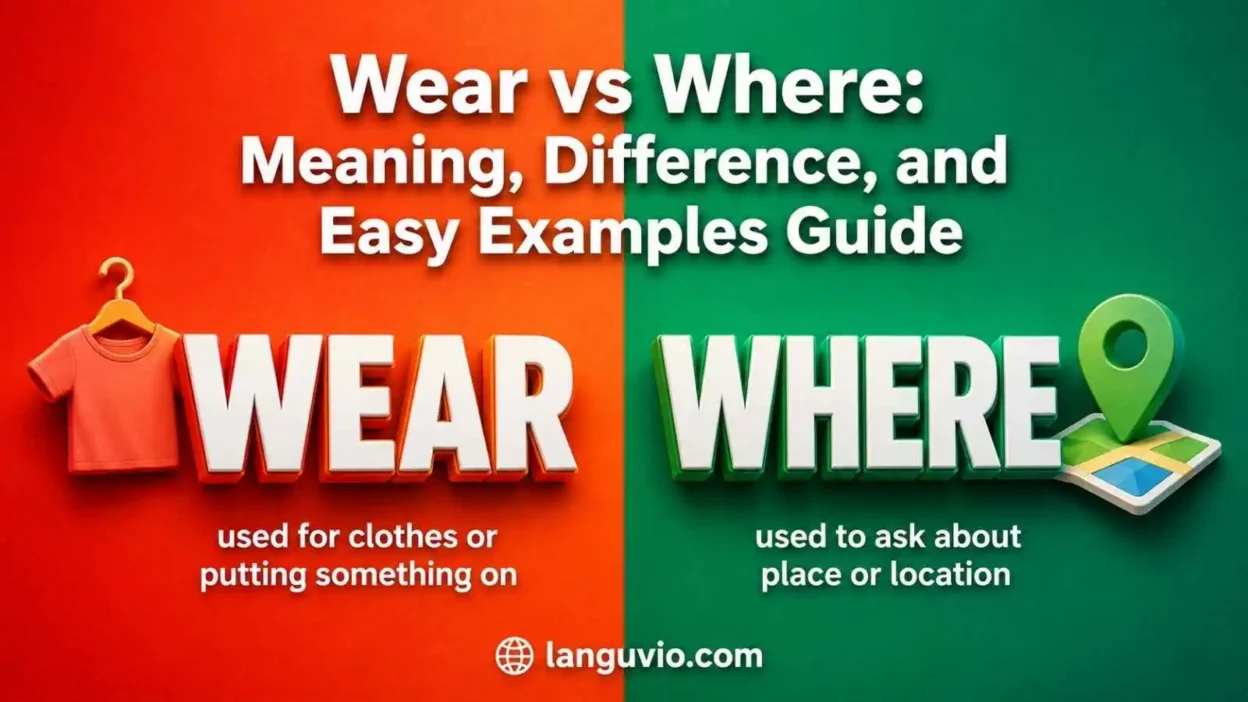
The difference is meaning. Wear usually talks about clothing, accessories, appearance, or damage from use. Where talks about place, location, position, stage, or situation.
Correct: What should I wear to the interview?
Correct: Where is the interview?
One sentence asks about clothing. The other asks about place. That is the whole difference.
Quick Answer
Use wear when you mean to have something on your body, to use clothing or accessories, or to become damaged over time.
Use where when you mean “in what place,” “to what place,” “at what place,” or “in what situation.”
Correct: I will wear a navy blazer.
Correct: Where did you buy that blazer?
Wear is mostly a verb. Where is mostly used to ask about or refer to a place.
Why People Confuse Them
People confuse wear and where because they are homophones. That means they sound alike but have different spellings and meanings.
In most US speech, both sound like “wair” or “wehr.” Some speakers may give where a slight “hw” sound, but many do not. In writing, pronunciation will not help much. Meaning is the safer guide.
The spelling clue is useful:
Wear has “ear,” and earrings are something you wear.
Where has “here,” and here is a place.
That trick is simple, but it works for most everyday sentences.
Key Differences At A Glance
| Context | Best Choice | Why |
| Clothing or accessories | wear | You wear a shirt, ring, watch, uniform, or glasses. |
| Asking about a place | where | Where asks for a location. |
| Referring to a place | where | It points to the place something happens. |
| Damage from use | wear | Shoes, tires, carpets, and tools can wear down. |
| Facial expression | wear | A person can wear a smile or worried look. |
| Stage or situation | where | It can refer to a point in a process or condition. |
Meaning and Usage Difference
Wear is the right word when the sentence is about having something on your body.
Examples:
I wear glasses when I drive.
She wore boots in the snow.
Do we need to wear badges at the event?
Wear can also mean that something becomes weaker, thinner, or damaged because of use.
Examples:
The tires will wear faster on rough roads.
The carpet is starting to wear near the stairs.
That joke is beginning to wear thin.
Where is the right word when the sentence is about place, direction, position, or situation.
Examples:
Where did you park?
This is where I grew up.
We reached a point where we had to decide.
Here is the compact grammar difference:
| Feature | wear | where |
| Main job | Verb for clothing, use, or damage | Location word |
| Common grammar role | Verb; also noun | Adverb or conjunction; rarely noun |
| Sounds like | “wair” / “wehr” | “wair” / “wehr” |
| Basic question | What are you wearing? | Where are you going? |
Tone, Context, and Formality
Wear and where do not differ by formality. One is not more polite, casual, or professional than the other.
The right choice depends on meaning.
In a work email, wear is correct if you are talking about clothing:
Please wear your ID badge during the tour.
In the same email, where is correct if you are talking about location:
Please confirm where the tour begins.
Using the wrong word can make a sentence confusing or careless because it changes the meaning.
Wrong: Where comfortable shoes to the site visit.
Correct: Wear comfortable shoes to the site visit.
Wrong: Do you know wear the meeting is?
Correct: Do you know where the meeting is?
Which One Should You Use?
Ask yourself one quick question: Is the sentence about clothing, use, or damage?
If yes, choose wear.
I need to wear something warm.
These headphones show a lot of wear.
The paint may wear off over time.
Now ask: Is the sentence about place, location, direction, or a point in a situation?
If yes, choose where.
Where is my jacket?
I know where we parked.
That is where the problem started.
For most sentences, this choice is clear once you identify what the word is doing.
When One Choice Sounds Wrong
Wear sounds wrong when the sentence needs a place word.
Wrong: Wear did you leave your phone?
Correct: Where did you leave your phone?
Where sounds wrong when the sentence needs a clothing or use word.
Wrong: I will where my black hoodie.
Correct: I will wear my black hoodie.
Wear also sounds wrong if you are asking for a location, even if clothing is mentioned.
Wrong: Wear is your coat?
Correct: Where is your coat?
Where also sounds wrong when something is becoming damaged by use.
Wrong: The soles of my shoes are starting to where out.
Correct: The soles of my shoes are starting to wear out.
Common Mistakes (and Quick Fixes)
Mistake: Using where for clothing.
Wrong: What should I where tonight?
Correct: What should I wear tonight?
Quick fix: If you can replace it with “put on,” use wear.
Mistake: Using wear for location.
Wrong: Wear are the keys?
Correct: Where are the keys?
Quick fix: If the answer could be “here,” “there,” “at home,” or “in the car,” use where.
Mistake: Writing where out instead of wear out.
Wrong: My laptop battery is starting to where out.
Correct: My laptop battery is starting to wear out.
Quick fix: Wear out means become used up, tired, or damaged.
Mistake: Forgetting that wore is the past tense of wear.
Wrong: She wear a red dress yesterday.
Correct: She wore a red dress yesterday.
Quick fix: Use wear for now or the future, and wore for the past.
Everyday Examples
Wear:
I usually wear sneakers on Fridays.
You should wear sunscreen at the beach.
He wore a suit to the graduation ceremony.
This jacket has a lot of wear, but I still like it.
The brake pads will wear down if you drive like that.
She wore a huge smile after the game.
Where:
Where did you get those sneakers?
Do you know where the ceremony starts?
This is the park where we met.
Where should we order lunch from?
I am not sure where I saved the file.
We are at the point where we need a final answer.
Both in one sentence:
Where did you find the hat you want to wear?
I do not know where my glasses are, but I need to wear them to read.
Wear your jacket if you are going where it is cold.
Dictionary-Style Word Details
Verb
Wear: Commonly used as a verb. It can mean to have clothing or accessories on your body, to show an expression, or to become damaged through use.
Examples:
I wear contacts.
He wore a nervous smile.
The steps have worn smooth.
Where: Not commonly used as a verb in standard US English.
Noun
Wear: Can be a noun. It may refer to clothing for a purpose or the damage caused by use.
Examples:
This store sells casual wear.
The couch shows normal wear.
Where: Can be a noun in limited phrases, usually when talking about location as a detail.
Example:
We need to know the where and when of the event.
This noun use is much less common than the adverb or conjunction use.
Synonyms
Wear: Exact synonyms depend on the meaning. Closest plain alternatives include have on, put on, dress in, erode, fray, and use up.
Where: Exact synonyms are limited because where has a grammar job. Closest plain alternatives include in what place, at what place, to what place, place, location, and site.
Antonyms do not fit neatly for the full meanings of wear and where. For the damage meaning of wear, a loose opposite may be preserve or protect, but that does not apply to clothing use.
Example Sentences
Wear:
Please wear closed-toe shoes in the lab.
I cannot wear wool because it bothers my skin.
The label is starting to wear off.
Where:
Where are we meeting after work?
I found the folder where you left it.
We reached a place where the trail split.
Word History
Wear is an old English word connected with clothing and use. Its modern forms include wear, wore, worn, and wearing.
Where is also an old English word connected with place or location. Its modern use still centers on asking about or pointing to place, position, or situation.
The exact history is not needed to choose between them. In modern writing, the meaning of the sentence gives you the answer.
Phrases Containing
Wear:
wear out
wear down
wear off
wear and tear
wear thin
wear your heart on your sleeve
ready-to-wear
Where:
where are you
where to
wherever possible
where it counts
where you stand
the where and when
where it all began
FAQs
Use wear when talking about clothing, accessories, appearance, or damage from use. Use where when talking about a place, location, direction, or situation.
Example:
I will wear my jacket.
Where is my jacket?
Wear usually means to have something on your body, like clothes, shoes, glasses, or jewelry. Where asks about or points to a place.
Example:
What should I wear to dinner?
Where are we going for dinner?
No. Where is not used for clothes. The correct word for clothes is wear.
Wrong: I will where a blue shirt.
Correct: I will wear a blue shirt.
No. Wear is not used to ask about places. The correct word for places is where.
Wrong: Wear is the store?
Correct: Where is the store?
In most American English speech, wear and where sound the same or very close. That is why people often confuse them in writing. The meaning of the sentence tells you which word to use.
Yes. Wear can be a noun when it means clothing for a purpose or damage caused by use.
Example:
This store sells athletic wear.
The couch shows normal wear.
Use this simple clue: wear has “ear,” and earrings are something you wear. Where has “here,” and “here” is a place.
Where did you buy the jacket you want to wear tonight?
I do not know where my shoes are, but I need to wear them.
Wear a coat if you are going where it is cold.
Conclusion
Wear vs where is a sound-alike problem, not a meaning problem.
Use wear for clothing, accessories, expressions, or damage from use. Use where for place, location, direction, or situation.
A quick memory clue: wear has “ear,” and earrings are something you wear. Where has “here,” and here is a place.