
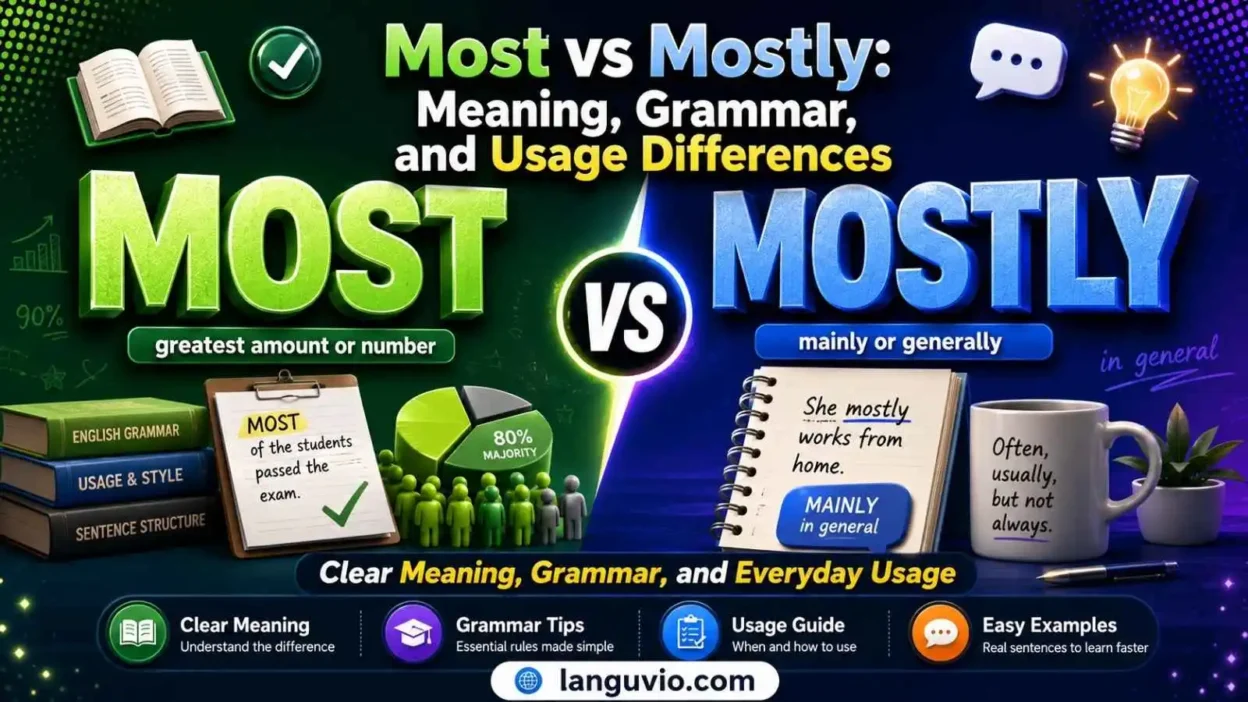
Most and mostly are both standard words, but they do different jobs. Most often points to a majority, the greatest amount, or the highest degree. Mostly describes something as true for the greater part, in general, or on most occasions.
The difference becomes easier when you look at what follows the word and what the sentence is trying to measure. Are you identifying the majority of a group? Use most. Are you describing the general makeup, condition, reason, or frequency of something? Mostly is usually the better fit.
Quick Answer
Use most when you mean the majority, the greatest number or amount, or the highest degree. It can appear before a noun, stand in place of a noun phrase, or help form a superlative.
Use mostly when you mean mainly, generally, or for most of the time. It is always an adverb and often modifies a verb, adjective, phrase, or whole statement.
- Most: “Most customers paid by card.”
- Mostly: “Customers mostly paid by card.”
- Core difference: The first sentence identifies the majority of customers. The second describes the payment method used in general.
Both sentences can describe a similar situation, but they organize the information differently.
Why People Confuse Them
The words look and sound alike because mostly is built from most plus the adverb ending -ly. Their meanings also overlap around the idea of a large part rather than the whole.
That overlap can make two sentences seem identical. Compare “Most guests arrived early” with “The guests mostly arrived early.” Both suggest that some guests may not have arrived early. However, the first sentence focuses on the number of guests. The second focuses on what generally happened.
Another source of confusion is that most has several grammatical roles. It can be a determiner in “most people,” a pronoun-like form in “most agreed,” or an adverb in “the most useful option.” Mostly has one main role: it functions as an adverb.
Key Differences At A Glance
| Context | Best Choice | Why |
| The majority of a general group | most | It directly limits a noun: “most voters.” |
| The majority of a specific group | most of | It comes before a determiner or pronoun: “most of the voters,” “most of them.” |
| The greatest amount or number | most | It expresses the highest quantity: “the most votes.” |
| A superlative with a longer adjective | most | It forms expressions such as “the most reliable.” |
| Mainly or for the greater part | mostly | It describes the general extent or makeup. |
| On most occasions | mostly | It describes a usual pattern: “We mostly cook at home.” |
| A condition that is not completely true | mostly | It allows a smaller exception: “The road is mostly clear.” |
Meaning and Usage Difference
Most commonly means the majority of something. Before a general plural or uncountable noun, it works as a determiner: “Most employees have direct deposit” and “Most traffic clears by 7 p.m.”
When the group is specific, most normally appears in the pattern most of + determiner or pronoun. Write “most of the employees,” “most of our budget,” or “most of them.” Do not write “most the employees.”
Most can also refer to the greatest amount, number, or degree. In “Maya received the most votes,” it compares Maya’s total with everyone else’s. In “This is the most practical route,” it helps form the superlative of practical.
Mostly means mainly, generally, or for the greater part.For composition, mostly can show what makes up the largest part: “The audience was mostly college students.” To describe degree, it may indicate that something is nearly finished: “The renovation is mostly complete.” When referring to frequency, mostly shows what usually happens: “We mostly work from home on Fridays.” A main cause can also be introduced with mostly: “The delay happened mostly because of road construction.”
The placement can change the focus. “Most students submitted the form online” counts students. “Students mostly submitted the form online” describes how submission generally happened.
For more guidance, read <a href=”https://dictionary.cambridge.org/grammar/british-grammar/most-the-most-mostly” target=”_blank” rel=”noopener noreferrer”>Cambridge Dictionary’s explanation of most, the most, and mostly</a>.
Tone, Context, and Formality
Both words are normal in everyday and formal American English. The main difference is grammatical function, not politeness or regional preference.
Most is direct and precise when a sentence discusses people, objects, amounts, or comparisons. News reports, workplace messages, academic writing, and conversation all use patterns such as “most residents,” “most of the data,” and “the most effective plan.”
Mostly has a slightly more descriptive feel because it qualifies a statement rather than naming an exact share. “The feedback was mostly positive” communicates a strong general pattern while allowing some negative or neutral responses. It does not state a percentage.
In careful writing, avoid treating mostly as an exact numerical term. It suggests the greater part or the usual pattern, but the sentence itself does not establish a precise cutoff. When a percentage matters, give the number.
Most can also mean “very” in a formal or old-fashioned-sounding structure, as in “That was most helpful.” This use is correct, but it does not mean the same as “That was mostly helpful.” The first means very helpful. The second means helpful in large part, though not completely.
Which One Should You Use?
Choose most when the next idea is a group, quantity, or maximum. “Most drivers,” “most of the work,” “the most time,” and “the most carefully” all point to quantity or the highest degree.
Choose mostly when you could naturally substitute mainly, generally, or for the most part. “The team is mostly new” means the team is mainly made up of new members. “I mostly agree” means you agree in general but may have reservations.
A useful test is to ask what you are emphasizing. If the answer is “which people or things make up the majority,” most is likely correct. If the answer is “what is generally true, how something usually happens, or what it is mainly made of,” mostly is likely correct.
Some sentences allow either word but shift the focus. “Most families shop on weekends” emphasizes the number of families. “Families mostly shop on weekends” emphasizes when shopping commonly occurs.
When One Choice Sounds Wrong
“Mostly people prefer flexible hours” sounds unnatural in standard usage because mostly does not normally serve as the determiner directly identifying a majority. Write “Most people prefer flexible hours.”
“The room was most empty” usually does not mean that the room was empty for the greater part. In a highly formal reading, most could mean “very,” but that is unlikely in ordinary conversation. Write “The room was mostly empty” when a few people or items remained.
“The committee was most teachers” is also wrong for composition. Use “The committee was mostly teachers.” Here, mostly describes what the committee was mainly composed of.
By contrast, “She completed mostly the assignment” has awkward placement. Write “She completed most of the assignment” when you mean the greater portion of a specific task. Write “She mostly completed the assignment” when the work was nearly or generally completed, though some parts may remain unfinished.
Be careful with most likely and mostly likely. “Most likely” means very probably and is the standard expression. “Mostly likely” is usually an error because mostly does not normally modify likely in that expression.
Common Mistakes (and Quick Fixes)
A frequent mistake is using mostly before a general noun: “Mostly stores close by nine.” Change it to “Most stores close by nine.”
Writers also omit of before a specific group. “Most the applicants arrived early” should be “Most of the applicants arrived early.” A possessive needs the same structure: “most of my coworkers,” not “most my coworkers.”
Another problem is adding the when the sentence means a general majority. “The most Americans drive to work” is incorrect for that meaning. Use “Most Americans drive to work.” Keep “the most” for a maximum or superlative, as in “This state has the most registered vehicles.”
Do not use most when you mean partial truth. “The instructions are most clear” suggests “very clear” in a formal style. “The instructions are mostly clear” means they are clear overall but contain some confusing parts.
Finally, avoid assuming that most and mostly always produce the same meaning. “I enjoyed most of the movie” refers to the larger portion of the movie. “I mostly enjoyed the movie” describes your general reaction. The difference is small but real.
Everyday Examples
Most mornings, Elena takes the train to downtown Chicago.
The train is mostly quiet before 7 a.m.
Most of our neighbors joined the block meeting.
Our neighbors mostly discussed parking and street repairs.
Jordan completed most of the report before lunch.
Jordan’s report was mostly complete before lunch.
Most restaurants in the area offer takeout.
The restaurants are mostly small, family-owned businesses.
Which applicant has the most experience?
The applicants were mostly recent college graduates.
Most customers liked the updated checkout process.
Customer comments were mostly positive.
The storm caused the most damage near the river.
The damage was mostly limited to fences and trees.
I agree with most of your proposal.
I mostly agree with your proposal, but I would change the timeline.
Dictionary-Style Word Details
Verb
Most: Not commonly used as a verb in standard US English.
Mostly: Not used as a verb. It functions as an adverb.
Noun
Most: Can function as a noun or pronoun-like form meaning the majority or the greatest amount. In “Most were ready,” most stands for most people. In “That is the most I can spend,” it means the greatest amount.
Mostly: Not used as a noun in standard US English.
Synonyms
Most: Meaning-matched alternatives depend on the sentence. For “the majority,” the closest plain alternative is “nearly all” or “the greater part.” For a maximum, alternatives include “the greatest amount” or “the highest number.” When most means “very” in formal use, “extremely” may fit.
Mostly: Common alternatives include “mainly,” “largely,” “generally,” “chiefly,” “primarily,” and “for the most part.” The best choice depends on whether the sentence describes composition, frequency, reason, or degree.
For the maximum sense of most, least is a clear opposite. Mostly does not have one exact opposite across every context, so an antonym should not be forced.
Example Sentences
Most: Most homeowners received the notice by mail. Most of the questions were straightforward. This route takes the most time. She responded most calmly during the emergency.
Mostly: The neighborhood is mostly residential. We mostly communicate by email. The repairs are mostly finished. Attendance dropped mostly because of the weather.
Word History
Most: The word has deep roots in Old English and has long expressed the greatest amount, number, or degree. Its modern uses as a quantity word, pronoun-like form, and superlative marker developed from that central idea.
Mostly: This word was formed by adding -ly to most. Its established adverb meaning is “for the greatest part” or “mainly.” The shared root explains the overlap, but the added ending gives mostly a narrower grammatical role.
Phrases Containing
Most: “most people,” “most of the time,” “the most important,” “at most,” “for the most part,” and “make the most of.”
Mostly: “mostly because,” “mostly due to,” “mostly made of,” “mostly finished,” “mostly sunny,” and “mostly agree.”
FAQs
What is the main difference between most and mostly?
Most refers to the majority, greatest amount, or highest degree. Mostly means mainly, generally, or for the greater part.
Is it correct to say “mostly people”?
No. Use most people when referring to the majority of people.
Correct: Most people use smartphones every day.
Incorrect: Mostly people use smartphones every day.
Is mostly always an adverb?
Yes. Mostly is an adverb. It can modify a verb, adjective, phrase, or complete statement.
Example: The project is mostly finished.
Can most be used without a noun?
Yes. Most can stand alone when the missing noun is understood.
Example: Several employees applied, but most lacked experience.
What is the difference between “most students” and “students mostly”?
Most students focuses on the number of students. Students mostly focuses on what the students generally do.
Most students submitted the assignment online.
Students mostly submitted the assignment online.
Should I write “most of people” or “most people”?
Write most people when speaking generally. Use most of the people when referring to a specific group.
Correct: Most people enjoy weekends.
Correct: Most of the people at the event stayed late.
Is it “most likely” or “mostly likely”?
Most likely is the correct expression. It means very probably.
Example: The package will most likely arrive tomorrow.
Does mostly mean completely?
No. Mostly means largely or for the greater part, so it usually allows some exceptions.
Example: The feedback was mostly positive, although a few customers reported problems.
Conclusion
Use most for a majority, the greatest quantity, or the highest degree. It commonly appears before nouns, in most of phrases, on its own when the missing noun is understood, and in superlatives.
Use mostly to mean mainly, generally, or for most of the time. It describes how true something is, what something is mainly made of, how an action usually happens, or what the main reason is.
The fastest check is simple: choose most when you are identifying or comparing a quantity. Choose mostly when you are describing a general pattern with possible exceptions.
Most refers to the majority, greatest amount, or highest degree. Mostly means mainly, generally, or for the greater part.
No. Use most people when referring to the majority of people.
Correct: Most people use smartphones every day.
Incorrect: Mostly people use smartphones every day.
Yes. Mostly is an adverb. It can modify a verb, adjective, phrase, or complete statement.
Example: The project is mostly finished.
Yes. Most can stand alone when the missing noun is understood.
Example: Several employees applied, but most lacked experience.
Most students focuses on the number of students. Students mostly focuses on what the students generally do.
Most students submitted the assignment online.
Students mostly submitted the assignment online.
Write most people when speaking generally. Use most of the people when referring to a specific group.
Correct: Most people enjoy weekends.
Correct: Most of the people at the event stayed late.
Most likely is the correct expression. It means very probably.
Example: The package will most likely arrive tomorrow.
No. Mostly means largely or for the greater part, so it usually allows some exceptions.
Example: The feedback was mostly positive, although a few customers reported problems.