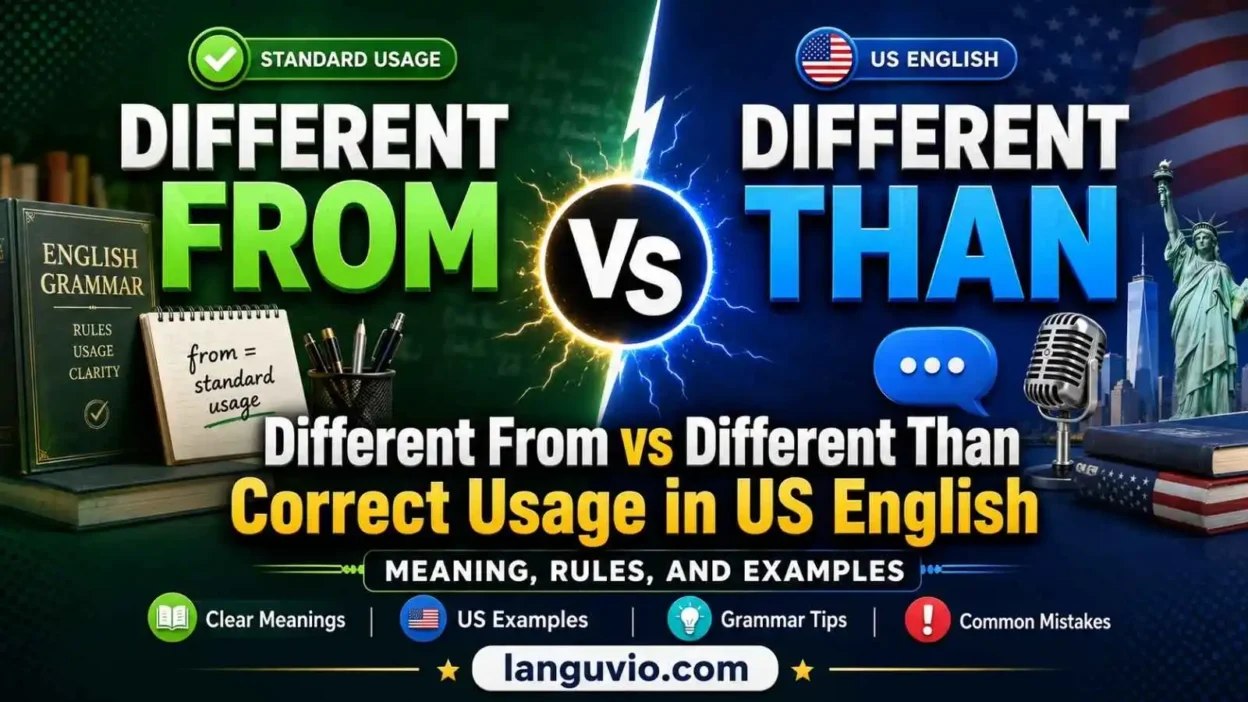
Both different from and different than appear in standard American English. However, they are not equally accepted in every sentence or by every reader.
The dependable choice is different from. It works in formal, academic, business, and everyday writing. Different than is also established in US English, especially when it introduces a clause or prevents an awkward sentence.
Quick Answer
Use different from as your default, especially before a noun, pronoun, or noun phrase:
“Jordan’s schedule is different from mine.”
Use different than when it leads into a clause and sounds smoother:
“The office looks different than it did last year.”
Both forms can be correct in American English. Still, different from is the safer choice when either version works equally well.
Why People Confuse Them
The adjective different creates a comparison, so than can feel natural because it commonly appears in comparative structures. At the same time, the related verb differ is normally followed by from, which supports different from.
Older classroom rules often treated different than as wrong in every setting. Modern American usage is more flexible. That conflict between a traditional preference and real usage keeps the question alive.
Sentence structure also matters. A short noun comparison usually favors from, while a full clause often favors than.
Key Differences At A Glance
| Context | Best Choice | Why |
| Before a noun | different from | It is the most widely accepted pattern. |
| Before a pronoun | different from | It sounds natural and avoids style objections. |
| Before a full clause | different than | It can introduce the clause directly and smoothly. |
| Formal or academic writing | different from | It is the safest choice across style preferences. |
| Casual US conversation | either | Both are common and usually clear. |
| International readership | different from | It is understood and accepted across major English varieties. |
Meaning and Usage Difference
The two expressions usually communicate the same basic idea: one person, thing, action, or situation is not the same as another. Their main difference is grammatical fit and editorial preference, not core meaning.
- Different from: Best as the general-purpose form, particularly before nouns and pronouns: “This estimate is different from the original.”
- Different than: Especially useful before a clause: “The result was different than we expected.”
In the second example, than connects different to the clause we expected. A version with from usually needs an added word: “The result was different from what we expected.”
This noun-versus-clause pattern is useful, but it is not an absolute law. American speakers sometimes use different than before nouns, and major dictionaries recognize that usage. Nevertheless, some readers still prefer different from in that position.
Tone, Context, and Formality
Different from has a neutral tone. It fits school assignments, reports, professional emails, news writing, and ordinary conversation.
Different than often sounds more conversational in simple noun comparisons:
“Her approach is different than mine.”
That sentence is normal in American English, yet some editors would change it to different from mine. Before a clause, however, different than can sound precise rather than casual:
“Remote work feels different than it did five years ago.”
For careful formal writing, choose different from unless than produces a cleaner clause. The goal is not to ban one form but to match the structure and audience.
Which One Should You Use?
Start with different from. It will be correct and natural in most situations.
Choose different than when the words after it form a clause with a subject and verb:
“The interview was different than I thought it would be.”
The same principle applies when rewriting with from would require what, how, or the way:
“The policy is different than it was in January.”
“The policy is different from what it was in January.”
Both are correct. The first is shorter, while the second may sound more formal.
When a noun follows, favor from:
“The policy is different from the proposal.”
When One Choice Sounds Wrong
Different from sounds incomplete when it is followed directly by a regular finite clause:
Incorrect: “The store looks different from it did before.”
Better: “The store looks different than it did before.”
Also correct: “The store looks different from how it looked before.”
Meanwhile, different than may sound unnecessary or disputed in a simple noun comparison:
Acceptable in US English: “This laptop is different than mine.”
Safer: “This laptop is different from mine.”
Neither meaning changes. The second version simply has broader acceptance.
Common Mistakes (and Quick Fixes)
A common mistake is treating different than as always incorrect. It has a long record in English and is accepted in American usage. Use it thoughtfully rather than rejecting it automatically.
Another mistake is forcing different from before a clause without adding a connector.
Weak: “The trip was different from I imagined.”
Correct: “The trip was different than I imagined.”
Correct: “The trip was different from what I imagined.”
Writers also sometimes mix the adjective pattern with the verb pattern. The verb is differ from, not differ than:
Correct: “The final design differs from the draft.”
Finally, keep the comparison parallel. Make sure readers can tell which two ideas are being compared.
Everyday Examples
“My new apartment is different from my old one.”
“Her management style is different from her predecessor’s.”
“The final price was different than the website had shown.”
“College feels different than it did during my first semester.”
“This coffee tastes different from the brand we usually buy.”
“The neighborhood looks different than I remember.”
“Our work hours are different from theirs.”
“The meeting was different than I expected.”
In each clause example, than allows the subject and verb to follow directly. In each noun or pronoun example, from gives the cleanest standard pattern.
Dictionary-Style Word Details
Verb
Different from: Not used as a verb. The full expression begins with the adjective different.
Different than: Not used as a verb. The full expression also begins with the adjective different.
Noun
Different from: Not commonly used as a noun in standard US English.
Different than: Not commonly used as a noun in standard US English.
Both are adjective-based comparison expressions rather than names for people, places, things, or ideas.
Synonyms
Different from: Closest plain alternatives include unlike, not the same as, and distinct from.
Different than: Closest plain alternatives include unlike, not the same as, or a clause rewritten with different from what or different from how.
For both expressions, the clearest opposite idea is the same as. Similar to may also work when the intended meaning is resemblance rather than exact sameness.
Example Sentences
Different from: “The updated contract is different from the version we reviewed.” “Maya’s answer was different from mine.”
Different than: “The event was different than I had pictured it.” “The software is different than it was before the update.”
Word History
Different from is the older of the two patterns, with written evidence reaching back to the 1400s. Different than has also been used for centuries and appears in writing from the early 1600s.
Objections to different than were recorded later, including criticism in the 1700s. Despite that history of criticism, the form remained in use. Today, different from is still more broadly accepted, while different than is established in American English.
Phrases Containing
Different from: different from mine, different from before, no different from, completely different from.
Different than: different than expected, different than it was, no different than, more different than.
FAQs
Is “different from” or “different than” correct?
Both expressions are correct in American English. However, different from is the safer and more widely accepted choice. It works naturally before nouns and pronouns. Different than is especially useful before a clause containing a subject and verb.
Should I use “different from” before a noun?
Yes. Different from is usually the best choice before a noun, pronoun, or noun phrase.
Correct: “This plan is different from the original proposal.”
Although Americans sometimes use different than in this structure, some readers and editors may prefer from.
Can “different than” introduce a clause?
Yes. Different than often sounds natural before a clause.
Example: “The restaurant looks different than it did last year.”
Using from would require an extra connecting word:
“The restaurant looks different from how it looked last year.”
Is “different than” grammatically wrong?
No. Different than is an established construction in American English. It appears in both speech and edited writing. Still, some traditional style preferences favor different from, especially before a noun or pronoun.
Which form is better for formal writing?
Use different from as your general choice in academic, professional, and formal writing. It has the broadest acceptance. However, different than may be clearer before a full clause when using from would make the sentence awkward.
Is “different than I expected” correct?
Yes. “Different than I expected” is correct and natural in American English.
You may also write:
“Different from what I expected.”
Both versions have the same basic meaning. The first is shorter, while the second may sound slightly more formal.
Is it “no different from” or “no different than”?
Both forms occur in American English.
“No different from” is the safer choice:
“His answer was no different from mine.”
“No different than” is also common, especially in conversation:
“Today feels no different than yesterday.”
Should I write “differs from” or “differs than”?
Use differs from. The verb differ normally takes from, not than.
Correct: “The final report differs from the first draft.”
Incorrect: “The final report differs than the first draft.”
This verb pattern does not change even though different than can be correct with the adjective different.
Conclusion
Both different from and different than can be correct in American English. Use different from as the reliable default, especially before nouns and pronouns. Use different than when it introduces a full clause or makes the sentence less awkward.
For the easiest rule to remember: choose from for broad acceptance and than when a following clause needs a smooth connection.
Both expressions are correct in American English. However, different from is the safer and more widely accepted choice. It works naturally before nouns and pronouns. Different than is especially useful before a clause containing a subject and verb.
Yes. Different from is usually the best choice before a noun, pronoun, or noun phrase.
Correct: “This plan is different from the original proposal.”
Although Americans sometimes use different than in this structure, some readers and editors may prefer from.
Yes. Different than often sounds natural before a clause.
Example: “The restaurant looks different than it did last year.”
Using from would require an extra connecting word:
“The restaurant looks different from how it looked last year.”
No. Different than is an established construction in American English. It appears in both speech and edited writing. Still, some traditional style preferences favor different from, especially before a noun or pronoun.
Use different from as your general choice in academic, professional, and formal writing. It has the broadest acceptance. However, different than may be clearer before a full clause when using from would make the sentence awkward.
Yes. “Different than I expected” is correct and natural in American English.
You may also write:
“Different from what I expected.”
Both versions have the same basic meaning. The first is shorter, while the second may sound slightly more formal.
Both forms occur in American English.
“No different from” is the safer choice:
“His answer was no different from mine.”
“No different than” is also common, especially in conversation:
“Today feels no different than yesterday.”
Use differs from. The verb differ normally takes from, not than.
Correct: “The final report differs from the first draft.”
Incorrect: “The final report differs than the first draft.”
This verb pattern does not change even though different than can be correct with the adjective different.