
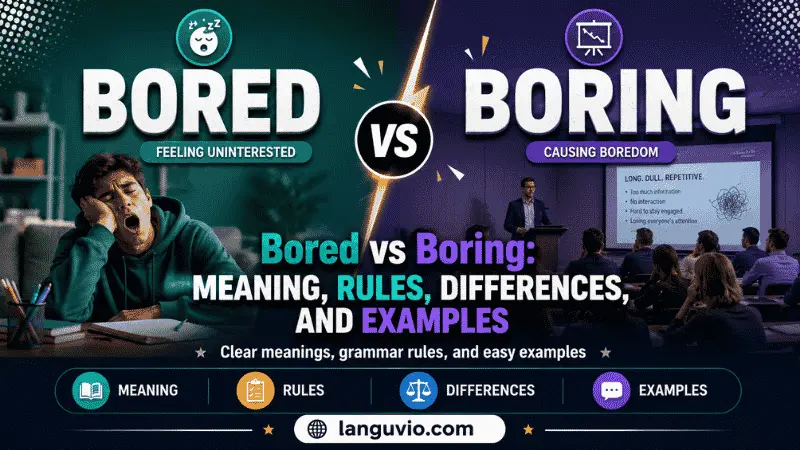
The difference between bored and boring depends on whether you are describing a feeling or the cause of that feeling. A person who has lost interest is bored. A movie, meeting, task, or person that causes someone to lose interest is boring.
This difference matters because switching the words can change your message completely. “I am bored” says that you need something more interesting to do. “I am boring” says that other people may find you uninteresting.
Both words are standard in American English. They often appear after forms of be, such as am, is, are, was, and were. However, they are not usually interchangeable. The subject’s role in the situation determines the correct choice.
Quick Answer
Use bored for the person or animal experiencing a lack of interest: “The kids were bored during the long wait.” Use boring for the person, thing, or situation causing that feeling: “The long wait was boring.” Both are correct adjectives, but they describe different sides of the same experience.
Why People Confuse Them
The words look similar because both come from the verb bore, meaning to make someone lose interest. They also commonly follow the same linking verbs:
- I am bored.
- I am boring.
- The students were bored.
- The students were boring.
Each sentence is grammatical, but the meaning changes. The -ed form points toward the receiver of the feeling. The -ing form points toward the source or cause.
Another reason for confusion is that people can fit either role. A speaker may feel bored during a meeting, yet the same speaker may also be boring the audience by repeating the same story. You cannot choose only by asking whether the subject is a person.
Key Differences At A Glance
- Bored: describes someone experiencing boredom.
- Boring: describes someone or something that causes boredom.
- Bored: often refers to a current or temporary state, though it can last a long time.
- Boring: gives an evaluation of a person, activity, place, object, or situation.
- Bored: “We were bored by the presentation.”
- Boring: “The presentation was boring.”
A useful test is to ask: Who feels the lack of interest, and what causes it? The one who feels it is bored. The cause is boring.
Meaning and Usage Difference
Bored means feeling uninterested, tired of an activity, or unhappy because nothing feels engaging. It usually describes a person or another living being capable of experiencing that state.
- Maya felt bored after an hour of waiting.
- The dog looked bored while everyone was away.
- His bored expression showed that he wanted to leave.
The last example does not mean the expression itself has feelings. It means the expression shows that the person feels bored.
Boring means not interesting or likely to make someone lose interest. It can describe people, objects, events, places, conversations, and activities.
- The training video was boring.
- That route is safe but boring.
- He can be boring when he talks only about work.
The difference is not simply “people versus things.” People can be boring, and animals can be bored. The more accurate contrast is experiencer versus cause.
Both words can also be forms of the verb bore. In “The speech bored everyone,” bored is the past-tense verb. In “The speech is boring everyone,” boring is part of the present progressive verb phrase. Context tells you whether the word is acting as an adjective or a verb form.
Tone, Context, and Formality
Both choices are standard and neutral enough for everyday speech, school writing, workplace communication, and most formal contexts. The main tone difference comes from what you are saying about the subject.
“I’m bored” reports your own state. It may sound casual, honest, impatient, or rude depending on the situation. Saying it during a friend’s story can suggest that the story does not interest you.
“You’re boring” is much more direct. It judges the other person as uninteresting and can sound insulting. A softer option is to focus on the activity or topic: “This part feels repetitive,” or “Could we move to the next point?”
Boring does not always describe a permanent quality. “The normally lively class was boring today” limits the judgment to that occasion. Likewise, bored is not always brief. Someone may feel bored with a job for months.
Which One Should You Use?
| Context | Best Choice | Why |
| You feel uninterested | bored | It describes your emotional state. |
| A movie causes little interest | boring | It describes the cause of the feeling. |
| Children have nothing to do | bored | The children experience the boredom. |
| A speaker makes listeners lose interest | boring | The speaker produces the effect. |
| A face or voice shows lack of interest | bored | It describes the feeling being displayed. |
| An activity feels dull or repetitive | boring | It evaluates the activity. |
Choose bored after verbs such as feel, seem, look, become, and get when the subject experiences the state:
- I feel bored.
- She looks bored.
- They got bored quickly.
Choose boring when the subject creates that reaction:
- The lecture seems boring.
- The game became boring.
- His stories get boring after a while.
When One Choice Sounds Wrong
Use bored, not boring, when you intend to report your own lack of interest.
Incorrect for the intended meaning: “I stayed home all day, so I was boring.”
Correct: “I stayed home all day, so I was bored.”
The first sentence says you were an uninteresting person. It does not say you lacked entertainment.
Use boring, not bored, for an object or event that lacks interest.
Incorrect: “The documentary was bored.”
Correct: “The documentary was boring.”
A documentary does not normally experience boredom. It can cause viewers to feel bored.
Some sentences can use either word, but the meanings remain different:
- “The students are bored” means they have lost interest.
- “The students are boring” means they are causing someone else to lose interest.
Common Mistakes (and Quick Fixes)
Mistake: “I am boring” when you mean you have nothing to do.
Fix: Say “I am bored.”
Mistake: Assuming every person must take bored.
Fix: A person can be boring when that person causes others to lose interest.
Mistake: Assuming boring always describes a lasting trait.
Fix: It can describe one moment, event, or performance: “Her presentation was boring today.”
Mistake: Using bored for an activity.
Fix: Say “The activity is boring” because the activity causes the feeling.
Mistake: Treating the words as simple past and present time markers.
Fix: Their adjective meanings concern feeling and cause, not time. Either can describe the past, present, or future.
Everyday Examples
- I was bored on the delayed flight, so I downloaded a podcast.
- The first half of the game was boring, but the ending was exciting.
- Are the kids bored, or do they just need a break?
- The weekly update becomes boring when every speaker reads directly from slides.
- Nina looked bored during the long checkout line.
- I do not think the museum is boring; I just need more time to explore it.
- Our dog gets bored when he stays inside all afternoon.
- The conversation was boring because nobody asked follow-up questions.
- He worried that his story was boring the group.
- We became bored with ordering from the same restaurant every Friday.
- The assignment sounded boring at first, but the research was enjoyable.
- She gave a bored sigh and checked the clock again.
Notice that opinions can differ. One person may call a show boring, while another finds it fascinating. The grammar rule stays the same even when the judgment is personal.
Dictionary-Style Word Details
Verb
- Bored: the simple past and past participle of bore when it means “made someone lose interest.” Example: “The repetitive speech bored the audience.”
- Boring: the present participle of bore. Example: “The repetitive speech is boring the audience.”
When used after be, context matters. “The audience is bored” uses bored as an adjective. “The speech is boring the audience” uses boring in a verb phrase.
Noun
- Bored: not commonly used as a noun in standard American English.
- Boring: not normally used as a noun for the feeling of boredom. It may function as a gerund in rare constructions, and it has a separate technical sense connected with making holes. Those uses do not affect this comparison.
The usual noun for the state is boredom, but boredom is not one of the compared terms.
Synonyms
- Bored: closest plain alternatives include uninterested, weary, restless, and fed up, depending on context. Helpful opposites include interested, engaged, and absorbed.
- Boring: close alternatives include dull, tedious, monotonous, tiresome, and uninteresting. Helpful opposites include interesting, engaging, lively, and entertaining.
These alternatives are not always exact. For example, restless may involve excess energy, while bored mainly points to a lack of interest or stimulation.
Example Sentences
- Bored: “I became bored while waiting for the software update to finish.”
- Bored: “The children looked bored after the third delay.”
- Bored: “She was bored with the same lunch options every day.”
- Boring: “The instructions were accurate but boring.”
- Boring: “That meeting becomes boring when the discussion repeats itself.”
- Boring: “He is not a boring person, but that story went on too long.”
Word History
- Bored: developed from the past-participle form of the verb bore in its sense of causing weariness or loss of interest.
- Boring: developed from the present-participle form of the same verb.
The origin of the “make someone lose interest” sense of bore is not fully certain. It is separate from the older physical sense involving drilling or making a hole, although some historical explanations have tried to connect them.
Phrases Containing
- Bored: bored with, bored by, bored of, bored to tears, bored stiff, and bored out of your mind.
- Boring: boring meeting, boring routine, boring person, boring job, and as boring as watching paint dry.
FAQs
Yes, say “I am bored” when you feel uninterested, restless, or lacking something engaging to do. “I am boring” has a different meaning: it says you cause other people to lose interest. The ending changes your role in the situation.
Yes, a person can experience boredom and cause boredom at the same time. A guest might feel bored at a party while telling a long, repetitive story that others find boring. Each adjective describes a different direction of the experience.
No, but it often sounds blunt because it judges someone’s ability to hold interest. Context and tone matter. “He was boring during the presentation” is narrower than “He is boring,” which can sound like a broad personal criticism.
Yes, bored can describe animals when their behavior suggests a lack of stimulation or interest. For example, “The puppy seemed bored indoors.” The animal experiences the state, while an unstimulating environment or repetitive routine may be boring.
They can be verb forms, but the common comparison concerns adjectives. “The lecture bored me” uses bored as a past-tense verb. By contrast, boring forms part of the progressive verb phrase in “The lecture is boring me.” In “I am bored,” however, bored functions as an adjective describing the speaker’s condition.
Yes, it makes sense when you mean that you were causing others to lose interest. For example, “I was boring everyone with too many details.” It does not mean that you felt uninterested; for that meaning, say “I was bored.”
Conclusion
Use bored for the person or animal that experiences a lack of interest. Use boring for the person, object, activity, or situation that causes that feeling.
Remember the direction: a boring meeting makes attendees bored. A boring speaker can face a bored audience. Once you identify the experiencer and the cause, the correct choice becomes clear.


