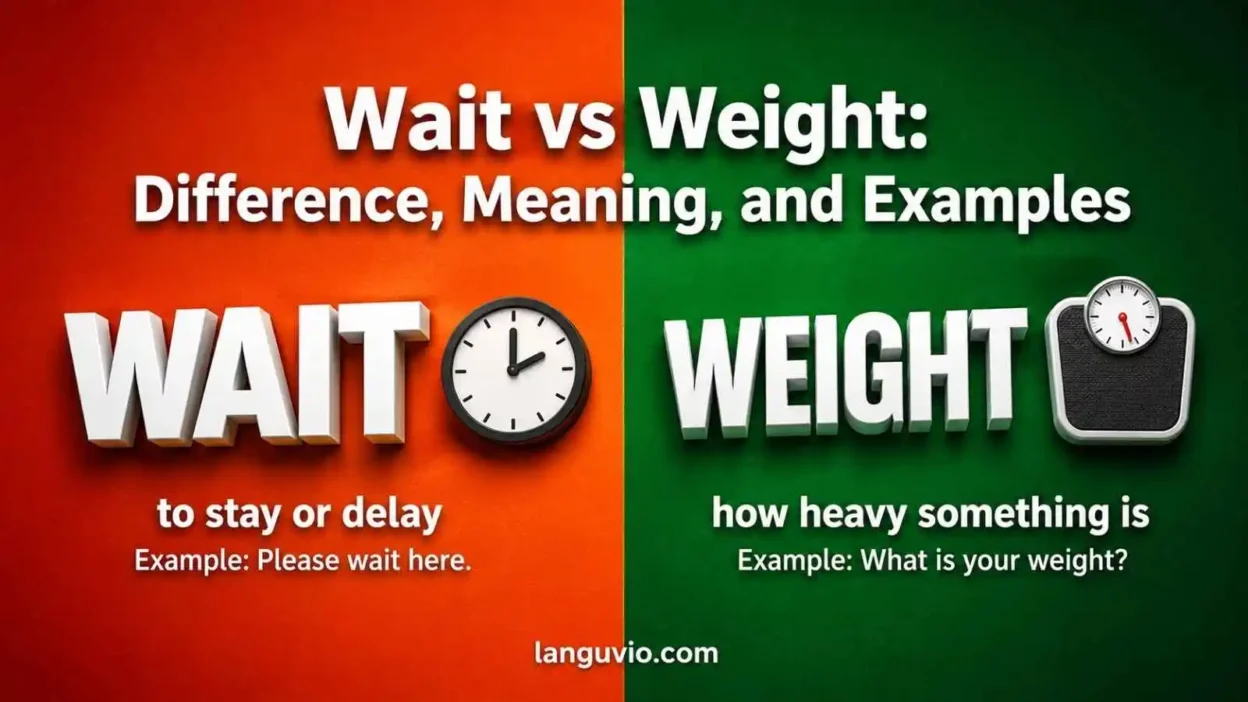
“Wait” and “weight” are both correct English words, but they do not mean the same thing.
Use wait when you mean to stay, pause, delay, or spend time until something happens. Use weight when you mean heaviness, a heavy object, body weight, or the importance given to something.
The confusion happens because the two words sound the same in everyday US English. In writing, though, spelling matters because the meanings are completely different.
Quick Answer
Wait is usually about time.
Example:
Please wait here until your name is called.
Weight is usually about heaviness.
Example:
The box’s weight is listed on the label.
A simple way to remember it: wait has to do with time; weight has to do with how heavy something is.
They are not interchangeable. “I need to weight for the bus” is wrong. “I need to wait for the bus” is correct.
Why People Confuse Them
People confuse wait and weight because they are homophones. That means they have the same pronunciation but different spellings and meanings.
Both are pronounced like wayt.
Because the sound does not help you choose the spelling, you have to choose by meaning. Ask yourself: Am I talking about time or heaviness?
If the sentence is about standing by, delaying, or expecting something, use wait. If the sentence is about pounds, size, heaviness, pressure, importance, or a heavy object, use weight.
Key Differences At A Glance
| Feature | Wait | Weight |
| Main meaning | To stay or delay until something happens | How heavy something is |
| Common use | Verb | Noun |
| Also used as | Noun meaning a delay | Verb meaning to add heaviness or importance |
| Pronunciation | wayt | wayt |
| Example | We had to wait outside. | The table can hold a lot of weight. |
The biggest difference is meaning, not sound. Wait points to time. Weight points to heaviness or importance.
Meaning and Usage Difference

Wait is most often a verb. It means to stay somewhere, pause, or delay action until something happens.
Examples:
Please wait by the front desk.
We had to wait twenty minutes for our table.
Don’t wait too long to apply.
Wait can also be a noun. As a noun, it means a period of waiting.
Examples:
There was a long wait at urgent care.
The wait for tickets was almost two hours.
Weight is most often a noun. It can mean the heaviness of a person or thing.
Examples:
What is the weight of this package?
She tracks her weight every week.
The shelf cannot hold that much weight.
Weight can also mean importance or influence.
Examples:
Her opinion carries a lot of weight on the team.
The judge gave more weight to the new evidence.
Weight can be a verb, but it is less common than the noun. As a verb, it means to make something heavier, hold something down, or give something more importance.
Examples:
They weighted the tent corners with rocks.
The final exam is weighted more than the quizzes.
Tone, Context, and Formality
Neither wait nor weight is more formal by itself. The right word depends on the topic.
Use wait in everyday situations involving time, service, travel, plans, appointments, and delays.
Examples:
I’ll wait in the car.
The doctor kept us waiting.
That email can wait until Monday.
Use weight in situations involving health, fitness, shipping, science, construction, sports, or importance.
Examples:
The airline checked the bag’s weight.
He lifted weights after work.
The board gave extra weight to customer feedback.
The phrase can also decide the choice. You wait for a person, lose weight, have a long wait, and lift weights.
Which One Should You Use?
| Context | Best Choice | Why |
| Staying until someone arrives | Wait | The meaning is about time or delay. |
| A delay before an appointment | Wait | A “wait” is a period of waiting. |
| Body heaviness | Weight | The meaning is how heavy someone is. |
| A heavy object at the gym | Weight | A “weight” can be exercise equipment. |
| Shipping a package | Weight | Packages are measured by heaviness. |
| Importance in a decision | Weight | “Weight” can mean influence or importance. |
| Holding something down | Weight | The verb means to add heaviness. |
| Standing in a line | Wait | The action is spending time until your turn. |
Choose wait when the sentence answers “How long?” or “Until when?” Choose weight when the sentence answers “How heavy?” or “How important?”
When One Choice Sounds Wrong
The wrong word often sounds fine when spoken because the pronunciation is the same. In writing, the mistake is easy to see.
Wrong: I need to weight for my ride.
Correct: I need to wait for my ride.
Wrong: She wants to lose wait before summer.
Correct: She wants to lose weight before summer.
Wrong: The wait of the couch made it hard to move.
Correct: The weight of the couch made it hard to move.
Wrong: There was too much weight at the restaurant.
Correct: There was too much wait at the restaurant.
Use the meaning test. Time means wait. Heaviness means weight.
Common Mistakes (and Quick Fixes)
Mistake: “Please weight here.”
Fix: “Please wait here.”
Use wait because the person is being asked to stay for a time.
Mistake: “I gained wait.”
Fix: “I gained weight.”
Use weight because the sentence is about body heaviness.
Mistake: “The wait limit is 50 pounds.”
Fix: “The weight limit is 50 pounds.”
Use weight because a limit in pounds is about heaviness.
Mistake: “The package wait is 12 pounds.”
Fix: “The package weight is 12 pounds.”
Use weight because the sentence is about measurement.
Mistake: “We had a long weight before dinner.”
Fix: “We had a long wait before dinner.”
Use wait because the sentence is about delay.
Mistake: “The tests are waited differently.”
Fix: “The tests are weighted differently.”
Use weighted when scores or factors receive different levels of importance.
Everyday Examples
I’ll wait outside until you finish shopping.
The weight of the suitcase was over the airline limit.
We had a 30-minute wait for a table.
The baby’s weight is checked at each appointment.
Don’t wait until the last day to renew your license.
These moving boxes are light, but that one has some weight to it.
Can you wait while I grab my keys?
The coach told us to lift lighter weights until our form improves.
Her recommendation carried real weight with the hiring manager.
The picnic blanket was weighted down with water bottles.
Dictionary-Style Word Details
Verb
• wait: Commonly used as a verb. It means to stay, pause, delay, or remain until something happens.
Example: Please wait until the meeting ends.
• weight: Used as a verb, but less often than as a noun. It means to add heaviness, hold something down, or give more importance to something.
Example: The survey results were weighted by age group.
Noun
• wait: A noun meaning a delay or period of waiting.
Example: The wait at the pharmacy was short.
• weight: A noun meaning heaviness, a heavy object, body heaviness, or importance.
Example: The bridge has a strict weight limit.
Synonyms
• wait: Closest plain alternatives include pause, stay, delay, remain, and hold on. For the noun, delay is often the closest choice.
Antonyms that may fit: go, leave, continue, proceed.
• weight: Closest plain alternatives include heaviness, load, mass in everyday use, burden, and importance when the meaning is influence.
Antonyms that may fit: lightness for heaviness, or unimportance for influence.
Not every synonym works in every sentence. “Stay” can replace wait in some sentences, but not in “the wait was long.” “Load” can replace weight in some physical contexts, but not in “her opinion carries weight.”
Example Sentences
• wait: We had to wait in line for coffee.
• wait: The wait was longer than expected.
• wait: I can wait until tomorrow for the update.
• wait: Don’t keep your guests waiting outside.
• weight: The weight of the box is printed on the label.
• weight: He lost weight after changing his routine.
• weight: Her experience gives her advice more weight.
• weight: The curtains were weighted at the bottom.
Word History
• wait: The word goes back to older forms connected with watching, guarding, or staying alert. Its modern sense of staying in expectation developed over time.
• weight: The word goes back to older English forms connected with weighing, heaviness, and downward force. Its figurative meaning of importance also became established over time.
The important point for modern writing is simple: the histories are different, and the meanings are different, even though the words sound alike today.
Phrases Containing
• wait:
can’t wait
wait and see
wait for
wait in line
wait your turn
long wait
worth the wait
wait around
lie in wait
• weight:
lose weight
gain weight
body weight
weight limit
light weight
heavy weight
carry weight
dead weight
pull your weight
weight of the world
weighted average
weighted down
FAQs
Wait means to stay, pause, or delay until something happens. Weight means how heavy something is, a heavy object, or the importance of something.
Example:
I will wait for you outside.
The box’s weight is 20 pounds.
Yes. Wait and weight are pronounced the same in everyday US English. They sound like wayt, but they have different spellings and meanings.
The correct phrase is wait for me. Use wait because the meaning is about staying until someone arrives or is ready.
Correct: Please wait for me at the door.
Incorrect: Please weight for me at the door.
The correct phrase is lose weight. Use weight because the phrase refers to body heaviness.
Correct: She wants to lose weight in a healthy way.
Incorrect: She wants to lose wait.
Yes. Wait can be a noun when it means a period of waiting or delay.
Example:
There was a long wait at the restaurant.
Yes. Weight can be a verb, though it is more common as a noun. As a verb, it means to make something heavier, hold something down, or give something more importance.
Example:
The scores were weighted differently.
Remember this simple rule: wait is about time, and weight is about heaviness.
Use wait when someone is staying or delaying. Use weight when something can be measured on a scale or carries importance.
Conclusion
Use wait for time, delay, staying, or expecting something. Use weight for heaviness, body measurement, a heavy object, or importance.
The two words sound the same, so pronunciation will not help much. Meaning will.
Remember it this way: wait is what you do with time; weight is what you measure on a scale.