Throne vs thrown is a simple but common word-choice problem. The words sound the same, but they mean very different things.
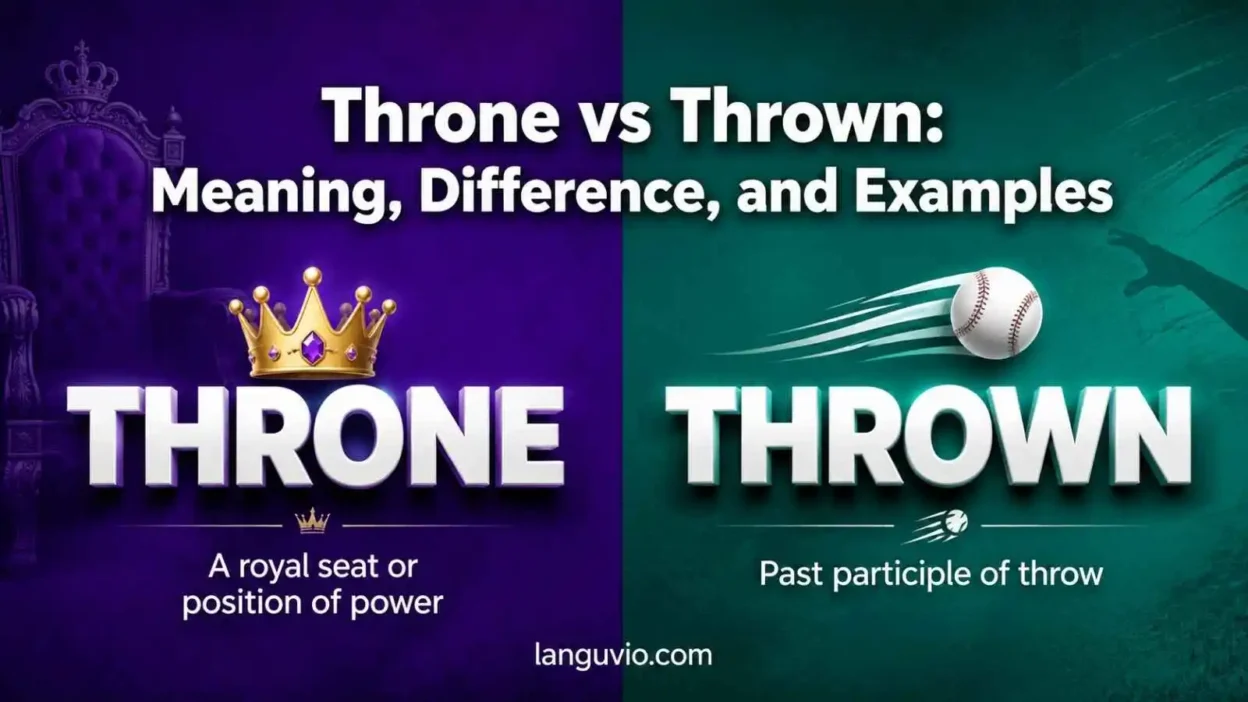
Throne usually means a royal or ceremonial chair. It can also mean royal power or the position of a king or queen. Thrown is connected to the verb throw. It means something has been tossed, hurled, moved, or put somewhere by force or action.
So, the correct choice depends on meaning. Use throne when you mean a royal seat or position of power. Use thrown when you mean the past participle of throw.
Quick Answer
Use throne for a royal seat or royal power.
Use thrown when something has been tossed, moved, or put somewhere by the action of throwing.
Correct: The queen sat on the throne.
Correct: The ball was thrown across the yard.
These words are homophones. That means they have the same sound but different spellings and meanings. In American English, both sound like THROHN, rhyming with alone and stone.
A fast memory tip: throne has one inside it, and a throne is often a special seat for one ruler. Thrown begins like throw, so it belongs with the action of throwing.
Why People Confuse Them
People confuse throne and thrown because pronunciation does not help. They sound the same in normal speech, so the mistake usually happens in writing.
The spelling also looks close. Both words start with thr and end with an n sound. However, their jobs in a sentence are different.
Throne points to a thing, place, rank, or symbol of authority. It often appears near words like king, queen, royal, palace, heir, or crown.
Thrown points to an action that already happened or a condition caused by that action. It often appears with helping verbs like has, have, had, was, were, or been.
Key Differences At A Glance
| Context | Best Choice | Why |
| A king or queen’s ceremonial chair | throne | It names a royal seat. |
| A position of royal power | throne | It can mean rule, rank, or succession. |
| Something tossed through the air | thrown | It is the past participle of throw. |
| Passive action | thrown | It often follows was, were, or been. |
| Perfect tense | thrown | It often follows has, have, or had. |
| Royal phrase | throne | Phrases like “ascend the throne” use throne. |
| Sports or objects moving by force | thrown | Balls, rocks, bags, and punches can be thrown. |
Meaning and Usage Difference
Throne is mainly a noun. It can mean the special chair used by a ruler during ceremonies. It can also mean the royal position itself.
Examples:
The king sat on the throne.
She is next in line to the throne.
Thrown is the past participle of throw. You use it after helping verbs or in passive sentences.
Examples:
The keys were thrown onto the table.
He has thrown three touchdown passes this season.
In short, throne names a royal seat or power. Thrown describes an action connected to throwing.
Tone, Context, and Formality
Throne often sounds formal, historical, royal, or symbolic. You may see it in stories, history writing, fantasy books, news about monarchies, or phrases about power.
Example: The prince hoped to inherit the throne.
It can also appear in casual humor as a playful word for a toilet, but that use depends on tone and audience.
Thrown is more everyday. It works in normal conversation, sports writing, accident reports, school writing, and casual messages.
Example: My backpack was thrown into the back seat.
Neither word is “more correct” by itself. They simply belong in different situations.
Which One Should You Use?
Choose throne when the sentence is about royalty, a ceremonial chair, a ruler’s position, or power.
Use throne in sentences like these:
The crown rested beside the throne.
The young ruler came to the throne after his father died.
Choose thrown when the sentence is about the action of throwing or the result of being moved suddenly.
Use thrown in sentences like these:
The ball was thrown too high.
She had thrown away the old receipt.
A helpful test is to replace the word with royal seat or tossed. If royal seat fits, use throne. If tossed fits, use thrown.
When One Choice Sounds Wrong
Throne sounds wrong when the sentence needs an action.
Wrong: The ball was throne across the field.
Correct: The ball was thrown across the field.
Thrown sounds wrong when the sentence needs a royal seat or position.
Wrong: The queen sat on the thrown.
Correct: The queen sat on the throne.
The mistake can change the sentence completely. A throne is something someone may sit on. Thrown describes what happened to something or someone.
If the sentence has was, were, has, have, or had before the word, check carefully. Those words often signal thrown, not throne.
Common Mistakes (and Quick Fixes)
Mistake 1: Using thrown for a royal chair.
Wrong: The king rose from his thrown.
Correct: The king rose from his throne.
Mistake 2: Using throne after a helping verb.
Wrong: The package was throne onto the porch.
Correct: The package was thrown onto the porch.
Mistake 3: Forgetting that thrown needs a connection to throw.
Wrong: She is next in line to the thrown.
Correct: She is next in line to the throne.
Mistake 4: Choosing by sound only.
Fix: Read the sentence for meaning. Royal seat means throne. Throwing action means thrown.
Everyday Examples
Here is a compact comparison:
- Throne = royal seat, royal rank, or symbol of power.
- Thrown = past participle of throw.
- Throne usually acts as a noun.
- Thrown usually works as part of a verb phrase.
- Throne appears in phrases about royalty.
- Thrown appears in sentences about movement, force, tossing, or sudden change.
More examples:
The museum displayed an old wooden throne.
The towel was thrown over the chair.
The princess refused to give up the throne.
The first pitch was thrown before sunset.
He dreamed of sitting on a golden throne.
The papers were thrown into the recycling bin.
Dictionary-Style Word Details
Verb
throne: Rarely, throne can work as a verb meaning to seat someone on a throne or place someone in royal authority. This use is uncommon in everyday US English.
Example: The ceremony throned the new ruler.
thrown: Thrown is the past participle of the verb throw. It commonly appears with has, have, had, was, were, or been.
Example: The jacket had been thrown on the floor.
Noun
throne: Throne is commonly used as a noun. It means a royal or ceremonial chair, royal power, or the position of a ruler.
Example: The queen sat on the throne.
thrown: Thrown is not commonly used as a noun in standard US English. The noun form connected to the action is throw, not thrown.
Example: He made a strong throw to first base.
Synonyms
throne: Closest plain alternatives include royal seat, ceremonial chair, seat of power, and sovereignty when the meaning is power rather than furniture.
Clear antonyms are not always useful because throne names a specific seat or position.
thrown: Closest plain alternatives include tossed, hurled, flung, cast, pitched, or sent, depending on the sentence.
Possible opposites depend on context. In some sentences, caught, held, or kept may work.
Example Sentences
throne: The king stepped down from the throne.
throne: She was next in line to the throne.
throne: The movie showed a silver throne in the palace hall.
thrown: The ball was thrown over the fence.
thrown: He had thrown his notes into the trash.
thrown: The sudden news thrown into the meeting would sound wrong; say “threw the meeting into confusion” or “left the meeting in confusion.”
Word History
throne: The word has a long history tied to words for a seat, especially an elevated or important seat. Its modern meaning still connects strongly to royalty, ceremony, and power.
thrown: Thrown belongs to the verb family of throw. It carries the idea of sending, moving, or putting something somewhere by force or sudden action.
The exact history is not needed to choose correctly in modern writing. The useful rule is meaning-based: royal seat or power takes throne; completed throwing action takes thrown.
Phrases Containing
throne:
ascend the throne
come to the throne
heir to the throne
next in line to the throne
the power behind the throne
throne room
thrown:
was thrown
has thrown
had thrown
thrown away
thrown out
thrown into confusion
thrown under the bus
FAQs
Is throne or thrown correct?
Both words are correct, but they mean different things. Use throne when you mean a royal seat or a position of power. Use thrown when you mean the past participle of throw.
What is the difference between throne and thrown?
Throne is mainly a noun. It means a royal chair or royal power. Thrown is a verb form. It means something has been tossed, moved, or sent by force.
Do throne and thrown sound the same?
Yes. Throne and thrown are homophones, so they sound the same in American English. Their spelling and meaning are different.
How do you use throne in a sentence?
Use throne when talking about royalty or power. Example: The queen sat on the throne during the ceremony.
How do you use thrown in a sentence?
Use thrown when something has been tossed or moved by force. Example: The ball was thrown across the field.
Is thrown a noun?
No, thrown is not commonly used as a noun in standard English. It is the past participle of throw. For a noun, use throw, as in: That was a strong throw.
Conclusion
Throne and thrown sound the same, but they are not interchangeable.
Use throne when you mean a royal seat, a ruler’s position, or a symbol of power. Use thrown when you mean the past participle of throw, especially after words like has, had, was, or been.
The easiest way to remember the difference is simple: throne belongs with royalty, and thrown belongs with throwing. If the sentence is about a king, queen, palace, or royal power, choose throne. If the sentence is about something tossed, moved, or sent by force, choose thrown.
Both words are correct, but they mean different things. Use throne when you mean a royal seat or a position of power. Use thrown when you mean the past participle of throw.
Throne is mainly a noun. It means a royal chair or royal power. Thrown is a verb form. It means something has been tossed, moved, or sent by force.
Yes. Throne and thrown are homophones, so they sound the same in American English. Their spelling and meaning are different.
Use throne when talking about royalty or power. Example: The queen sat on the throne during the ceremony.
Use thrown when something has been tossed or moved by force. Example: The ball was thrown across the field.
No, thrown is not commonly used as a noun in standard English. It is the past participle of throw. For a noun, use throw, as in: That was a strong throw.