
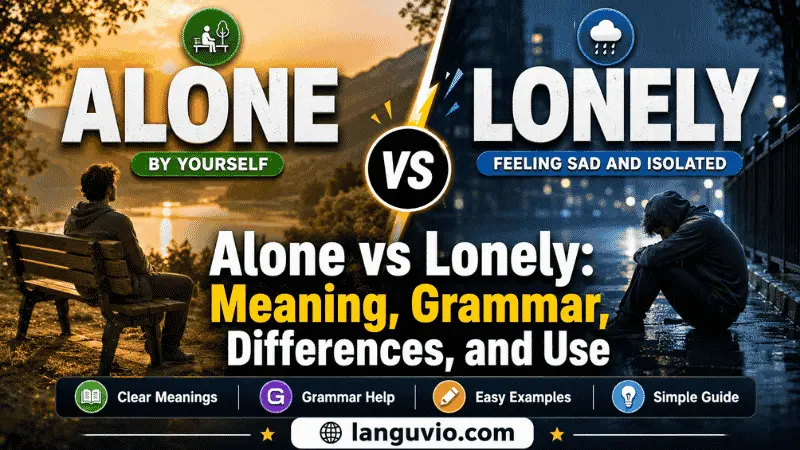
Alone and lonely both relate to separation from other people, but they do not express the same idea. Alone usually describes a situation: no one else is present, or someone does something without help. That situation may feel peaceful, useful, uncomfortable, or neutral.
Lonely usually describes an unhappy feeling caused by missing companionship or meaningful connection. A person can therefore be alone without feeling lonely. A person can also feel lonely while sitting with coworkers, friends, or family.
Grammar matters too. Alone works as both an adjective and an adverb, while lonely works as an adjective. Their sentence positions also differ. Understanding those differences makes the right choice much easier.
Quick Answer
Use alone when you mean “by yourself,” “without other people,” or “without help.” Use lonely when you mean “sad, isolated, or disconnected because companionship is missing.”
- “I spent Saturday alone” states who was present.
- “I felt lonely on Saturday” describes an emotion.
Both words are correct, but they are not normally interchangeable.
Why People Confuse Them
The words overlap because being alone can lead to loneliness. In everyday life, the situation and the emotion often happen together. Someone who moves to a new city may live alone and also feel lonely.
The overlap is not complete, however. Chosen time alone may be relaxing. At the same time, a person at a crowded event may feel lonely because no conversation feels genuine.
Another source of confusion is the phrase feel alone. It is standard English and can express emotional isolation or lack of support. It comes close to feel lonely, but it often emphasizes being unsupported, misunderstood, or left to handle something without help.
Key Differences At A Glance
- Alone: usually states a condition, arrangement, or lack of help.
- Lonely: usually expresses sadness, disconnection, or longing for company.
- Alone: can be an adjective or an adverb.
- Lonely: is an adjective.
- Alone: usually follows a linking verb when it acts as an adjective.
- Lonely: can come before a noun or after a linking verb.
- Alone: can also mean “only” or “solely.”
- Lonely: can describe a remote or isolated place, road, house, or period.
The simplest memory aid is this: alone tells you about company; lonely tells you about connection and feeling. Still, context can add emotional meaning to alone, especially after feel, seem, or look.
Meaning and Usage Difference
Alone has several common uses.
First, it can mean that no other person is present:
Maya was alone in the conference room.
Second, it can mean that someone acts without company or assistance:
Jordan assembled the desk alone.
Third, it can mean “only” or “solely”:
The delivery fee alone made the order too expensive.
In the first use, alone acts as an adjective after was. In the second and third uses, it acts adverbially.
Lonely most often describes an unhappy sense of isolation:
After everyone left campus, Devon felt lonely.
It can also describe something associated with isolation, remoteness, or sadness:
They drove along a lonely desert road.
Here, the road does not have a human emotion. Lonely creates the idea of remoteness, emptiness, or an atmosphere that may make a person feel isolated.
One important qualification is feel alone:
I felt alone while making the final decision.
This sentence may mean that the speaker felt unsupported, even if other people were nearby. I felt lonely would focus more directly on sadness and a lack of satisfying connection.
For further clarification, see Cambridge Grammar’s guide to alone and lonely, which explains the grammatical and emotional difference between these words.
Tone, Context, and Formality
Both words are standard in formal and informal American English. The main difference is tone, not level of formality.
Alone is often neutral. “She works alone” does not tell us whether she likes the arrangement. Context can make the word positive, negative, or practical:
- “I enjoy being alone before work” sounds positive.
- “The child was left alone” sounds concerning.
- “He finished the report alone” emphasizes independent effort.
Lonely usually has a negative emotional tone. It suggests that the person wants more company, understanding, or closeness:
- “She felt lonely after moving.”
- “It was a lonely holiday weekend.”
Sentence position also matters. Alone is not normally placed directly before a noun. Write “the student was alone,” not “an alone student.” Lonely can appear before a noun: “a lonely student.”
Which One Should You Use?
Choose the word that matches the meaning you actually want to express.
| Context | Best Choice | Why |
| No other person is present | alone | It states the factual situation. |
| Someone acts without help | alone | It shows independence or lack of assistance. |
| Someone feels emotionally disconnected | lonely | It names the unhappy feeling. |
| A person wants privacy | alone | Privacy does not automatically involve sadness. |
| A road, cabin, or area seems remote | lonely | It can describe an isolated setting or mood. |
| The meaning is “only” or “solely” | alone | Lonely does not carry this meaning. |
| Someone feels unsupported | alone or lonely | Alone stresses lack of support; lonely stresses emotional disconnection. |
A useful test is to ask two questions. Who is physically or practically present? points toward alone. How does the person feel about connection? points toward lonely.
When One Choice Sounds Wrong
Some sentences become unnatural because the words do not share the same grammar.
Incorrect: I prefer to eat lonely.
Correct: I prefer to eat alone.
The sentence describes how the person eats, so it needs the adverb alone.
Incorrect: An alone customer waited by the door.
Correct: A customer waited alone by the door.
Correct: A lonely customer waited by the door.
The first correction states that no one else was with the customer. The second suggests that the customer felt isolated or appeared unhappy.
Misleading: The apartment was lonely when my roommate traveled.
Clearer: I was lonely in the apartment when my roommate traveled.
A place can be called lonely, but this version makes the person’s emotion clearer.
Incorrect: Price lonely made me cancel.
Correct: Price alone made me cancel.
Only alone can mean “by itself” or “without considering anything else.”
Common Mistakes (and Quick Fixes)
Mistake: Treating every solitary person as unhappy.
Quick fix: Use alone unless the sentence clearly communicates sadness or disconnection.
Mistake: Using lonely to describe an action.
Quick fix: Write “walked alone,” “worked alone,” or “traveled alone.”
Mistake: Putting alone before a noun.
Quick fix: Move it after the noun and verb: “The driver was alone.”
Mistake: Assuming lonely requires physical solitude.
Quick fix: Remember that someone can feel lonely in a full classroom, busy office, or family gathering.
Mistake: Calling feel alone incorrect.
Quick fix: Use it when the person feels unsupported, misunderstood, or emotionally separate. Use feel lonely when the focus is a desire for companionship or connection.
Mistake: Replacing alone when it means only.
Quick fix: Keep alone in sentences such as “That reason alone is enough.”
Everyday Examples
These examples show how the choice changes with meaning:
- Nina lives alone, but her neighbors visit often.
- Nina rarely feels lonely because she has close friends nearby.
- I need to be alone for an hour so I can concentrate.
- Marcus felt lonely during his first week at college.
- The technician repaired the machine alone.
- We passed a lonely farmhouse miles from the nearest town.
- Being alone on the train gave me time to read.
- She felt lonely at the party because no one included her.
- The evidence alone did not prove who caused the damage.
- Even with the whole team present, I felt alone in opposing the decision.
- Their dog becomes lonely when everyone leaves for the day.
- Please leave me alone while I finish this call.
Notice that alone does not automatically express an emotion. The emotional force comes from the surrounding sentence. Lonely, by contrast, normally introduces sadness, isolation, or an empty atmosphere.
Dictionary-Style Word Details
Verb
- Alone: Not commonly used as a verb in standard US English.
- Lonely: Not commonly used as a verb in standard US English.
Use a linking verb before either adjective when needed: “She was alone” or “She felt lonely.”
Noun
- Alone: Not commonly used as a noun. The related noun aloneness names the state of being alone.
- Lonely: Not commonly used as a regular noun. The related noun loneliness names the feeling or condition of being lonely.
In expressions such as “the lonely,” lonely is a nominalized adjective referring generally to lonely people, not a standard singular count noun.
Synonyms
- Alone: Closest plain alternatives include by oneself, unaccompanied, and independently. In the “only” sense, solely is a close alternative. Helpful opposites include together and accompanied.
- Lonely: Closest plain alternatives include lonesome, sad and isolated, and disconnected. For a place, remote or deserted may fit. A helpful emotional opposite is connected.
No single replacement fits every sentence because both words have more than one use.
Example Sentences
- Alone: The attorney asked to speak with her client alone.
- Alone: That delay alone could change the schedule.
- Alone: We cannot complete the move alone.
- Lonely: Eli felt lonely after his closest coworker transferred.
- Lonely: A lonely light glowed at the end of the street.
- Lonely: The long winter evenings sometimes felt lonely.
Word History
- Alone: The word developed from Middle English forms built from words meaning “all” and “one,” giving the sense of being entirely by oneself.
- Lonely: The word is historically connected to lone, a shortened form related to alone, plus the adjective-forming ending -ly.
That shared history helps explain the overlap, but modern usage gives lonely a stronger emotional meaning.
Phrases Containing
- Alone: alone time, all alone, leave someone alone, live alone, go it alone, stand alone, alone together
- Lonely: feel lonely, get lonely, lonely heart, lonely road, lonely place, lonely night, lonely at the top
These phrases are not automatic substitutes for one another. “Alone time” may be welcome, while a “lonely night” usually sounds unwanted or sad.
FAQs
Yes. Being alone only means that no other person is with you, or that you are doing something without help. You may enjoy the quiet, focus better, or recharge. Loneliness appears when the lack of connection feels unwanted, painful, or emotionally empty.
Yes. Loneliness depends on the quality of connection, not simply the number of people nearby. Someone may feel lonely at a party, in a relationship, or among coworkers when they feel unseen, misunderstood, excluded, or unable to communicate honestly.
“I feel alone” often emphasizes having no support, sharing a burden by yourself, or feeling separate from others. “I feel lonely” more directly describes sadness caused by missing companionship or closeness. Both are natural, but the emotional focus is slightly different.
No, not in ordinary standard US English when you mean that no one shares your home. Say “I live alone.” Because lonely is an adjective, it can follow a linking verb instead: “I feel lonely,” especially when living alone causes unhappiness.
Yes. Lonely can describe a remote, empty, or isolated place, as in “a lonely road” or “a lonely cabin.” The place does not literally feel sadness. The adjective suggests little company, few visitors, or an atmosphere that creates isolation.
Alone can be either. It is an adjective in “The manager was alone” and an adverb in “The manager worked alone.” Lonely is an adjective, so it works in “a lonely manager” or “the manager felt lonely,” but not “worked lonely.”
Conclusion
Use alone for the fact of being by yourself, acting without help, or meaning “only.” Use lonely for sadness, disconnection, or an isolated atmosphere.
The two ideas can overlap, but they are not the same. You can enjoy being alone, feel lonely in company, or feel alone when no one supports you. Choose the word that matches both the sentence structure and the intended meaning.


