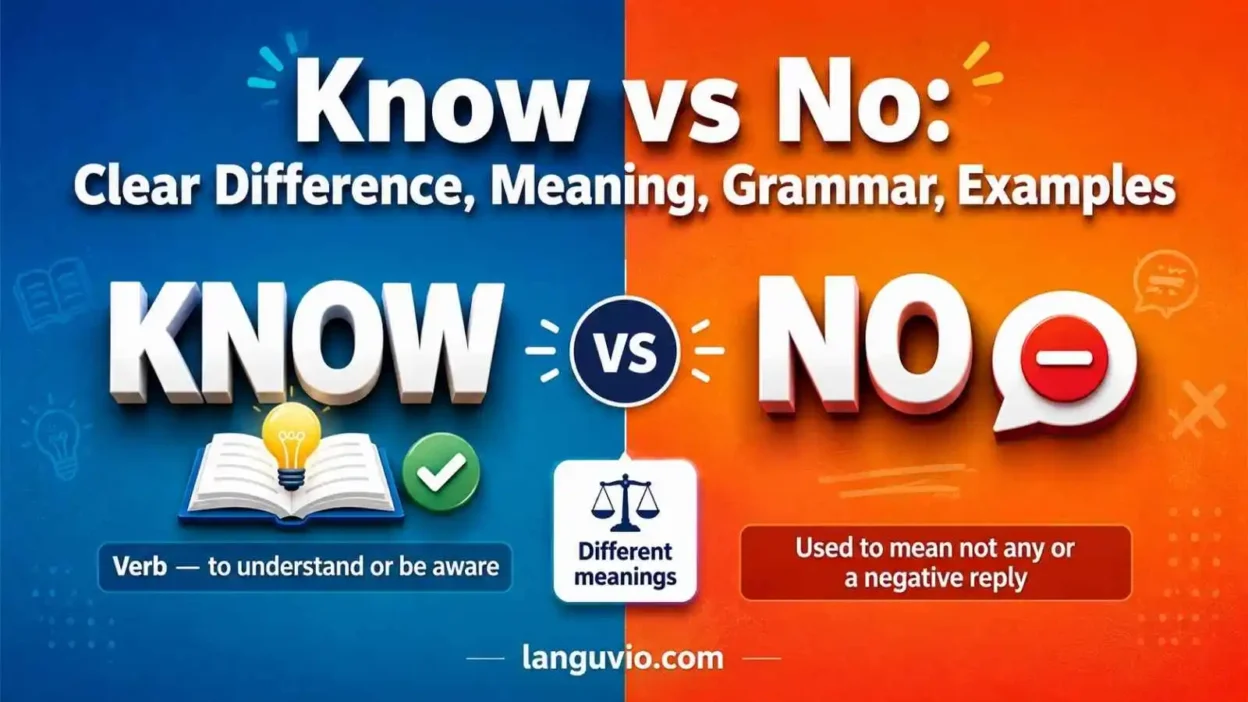
Know vs no is a common word-choice problem because both words sound the same in American English. Although the pronunciation is identical, the meanings are completely different.
In writing, this difference matters. Know is about information, understanding, recognition, or familiarity. No is about refusal, denial, absence, or negation.
Once you understand the job each word does, the correct choice becomes much easier.
Quick Answer
Choose know when you mean “understand,” “be aware of,” “recognize,” or “be familiar with.”
Choose no when you mean “not any,” “not allowed,” “a negative answer,” or “refusal.”
Examples:
I know the answer.
No, I don’t want coffee.
There is no reason to wait.
The phrase “I don’t no” is incorrect. After don’t, the sentence needs a main verb. The correct phrase is “I don’t know.”
Why People Confuse Them
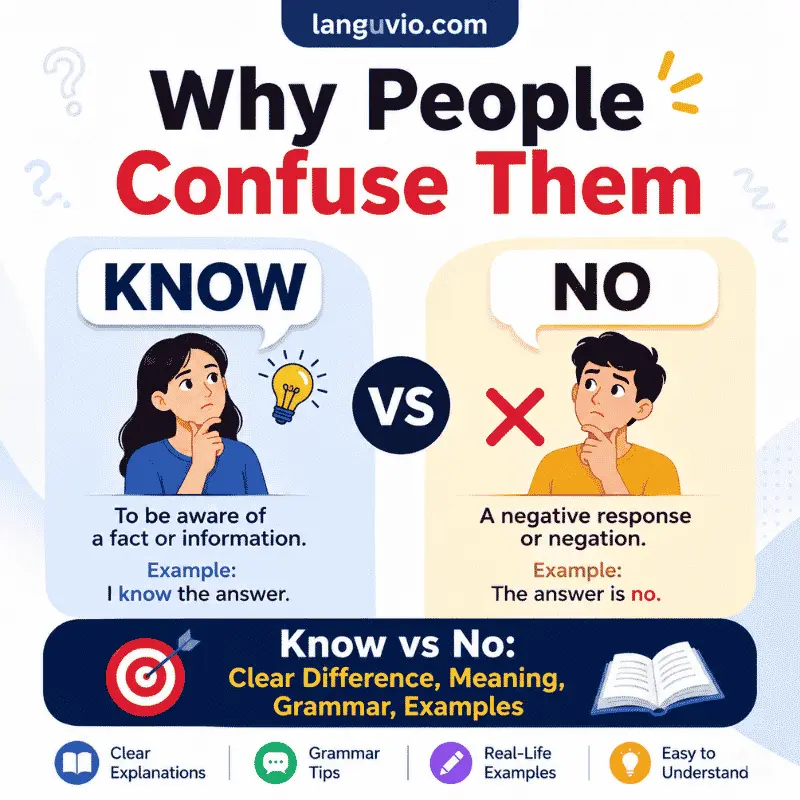
The confusion happens because know and no are homophones. Homophones sound the same but have different meanings and spellings.
Both words are pronounced like “noh” in American English. The k in know is silent, so readers cannot hear the spelling difference in spoken conversation.
Because of that, the mistake usually appears in writing. Someone may hear the word correctly but type the wrong spelling.
A helpful memory trick is simple: the k in know can remind you of knowledge.
Key Differences At A Glance
Here is the basic difference:
- Know is usually a verb. It means to understand, recognize, be aware of, or be familiar with something.
- No is a negative word. It can mean not any, not one, refusal, denial, or a negative answer.
- Know often appears after a subject: I know, she knows, they know.
- No often stands alone or comes before a noun: No, thanks. No tickets are left.
The two words are not interchangeable. They only sound alike.
Meaning and Usage Difference
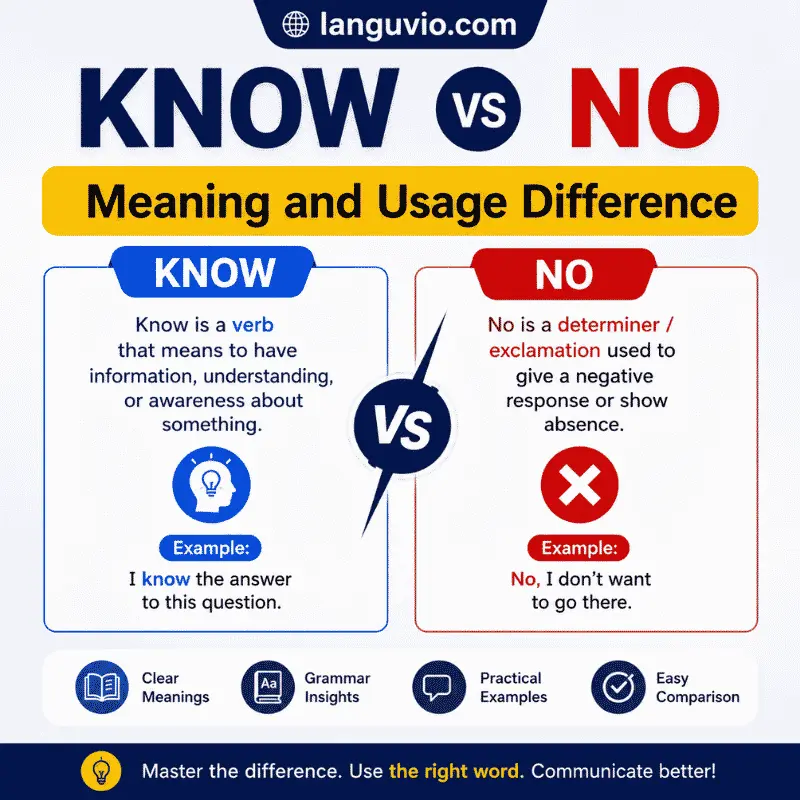
Know is mainly used as a verb. It tells the reader that someone has information, understands something, recognizes someone, or is familiar with a fact, person, place, or skill.
Examples:
I know her from work.
Do you know where the office is?
He knows how to fix the printer.
No works differently. It gives a negative answer, denies something, or shows that something does not exist or is not allowed.
Examples:
No, I can’t come tonight.
We have no extra chairs.
The sign says no parking.
So, if the sentence needs a word about knowledge or awareness, choose know. When the sentence needs a negative answer or absence, choose no.
Tone, Context, and Formality
Know is neutral. It works in casual speech, school writing, workplace emails, and formal writing.
No can also be neutral, but its tone depends on context. It may sound polite, firm, direct, or blunt.
Examples:
No, thank you.
No, that won’t work.
There is no evidence for that claim.
In formal writing, no often appears before nouns such as reason, evidence, change, issue, or problem. In everyday speech, it can stand alone as a complete answer.
The word know does not become formal or informal by itself. Its tone depends on the full sentence.
Which One Should You Use?
| Context | Best Choice | Why |
| You mean “understand” | know | It is the verb for having knowledge |
| You answer negatively | no | It gives a negative answer |
| You mean “not any” before a noun | no | It shows absence |
| The word follows don’t, doesn’t, or didn’t | know | The sentence needs the verb know |
| You mean “be familiar with” | know | It shows recognition or familiarity |
| A sign or rule says something is not allowed | no | It marks refusal or prohibition |
A quick test can help. If you can replace the word with “understand,” use know. If you can replace it with “not any” or a negative answer, use no.
When One Choice Sounds Wrong
The word know sounds wrong when the sentence needs a negative word.
Incorrect: There is know milk left.
Correct: There is no milk left.
The word no sounds wrong when the sentence needs a verb about information.
Incorrect: I no the answer.
Correct: I know the answer.
This also explains why “don’t no” is wrong. Don’t already creates the negative meaning. After that, the sentence still needs the verb know.
Correct: I don’t know.
Incorrect: I don’t no.
Common Mistakes (and Quick Fixes)
Mistake: I no what you mean.
Fix: I know what you mean.
Mistake: She doesn’t no the address.
Fix: She doesn’t know the address.
Mistake: There is know way to finish today.
Fix: There is no way to finish today.
Mistake: No one know the answer.
Fix: No one knows the answer.
Mistake: I have know idea.
Fix: I have no idea.
The phrase “no idea” is correct because no means “not any.” The phrase “know idea” is not standard English.
Everyday Examples
I know your sister from college.
No, I haven’t seen that movie yet.
Do you know the Wi-Fi password?
There are no clean cups in the cabinet.
We know this route is faster.
No pets are allowed in the building.
The team doesn’t know why the meeting was moved.
She said no because she already had plans.
My neighbor knows a good mechanic nearby.
There is no need to apologize.
After a few examples, the pattern becomes clear. Know connects to information. No creates a negative meaning.
Dictionary-Style Word Details
Verb
As a verb, know means to have information, understand something, recognize someone, or be familiar with a fact, place, person, or skill.
Example: I know how to change the tire.
By contrast, no is not commonly used as a verb in standard US English. It should not replace know when the sentence is about understanding or awareness.
Example: No, I don’t agree.
Noun
In noun use, know is rare. It mostly appears in the phrase “in the know,” which means informed about something that not everyone knows.
Example: People in the know heard the update early.
As a noun, no can mean a negative answer, decision, or vote.
Example: Her answer was a clear no.
Synonyms
For know, the closest plain alternatives include understand, recognize, realize, be aware of, and be familiar with. The best replacement depends on the sentence.
For no, close alternatives include not any, none, negative answer, refusal, and denial. When no is used as an answer, yes is the clearest opposite.
These two words are not synonyms. Their only real connection is pronunciation.
Example Sentences
For know:
I know the deadline is Friday.
Do you know anyone who can help us move?
We don’t know the full story yet.
For no:
No, I’m not available tomorrow.
There were no seats left.
The form gave us a yes-or-no choice.
Word History
The word know comes from older English forms connected with recognizing, perceiving, and understanding. Its spelling still keeps the silent k, even though modern speakers do not pronounce it.
The word no developed from older negative forms meaning “not” or “not any.” Over time, it became the everyday English word for refusal, denial, and absence.
Their meanings are not closely related. The confusion comes from modern pronunciation, not from shared meaning.
Phrases Containing
Common phrases with know include know better, know the answer, know how, know your way around, in the know, you know, and as far as I know.
Common phrases with no include no problem, no way, no doubt, no reason, no entry, no parking, no idea, and yes or no.
These phrases make the difference easier to see. Know points to information or familiarity. No points to refusal, absence, or negation.
FAQs
Know means to understand, recognize, or be aware of something. No means “not any,” “not allowed,” or a negative answer. For example, “I know the answer” uses know, while “No, I can’t go” uses no.
The correct phrase is I don’t know. After “don’t,” the sentence needs a main verb, and know is the verb that means to understand or have information.
Yes. In American English, know and no are pronounced the same way, like “noh.” The k in know is silent.
Use know when you mean understand, recognize, remember, or be familiar with something. For example: “Do you know her?” or “I know how to fix it.”
Use no when you mean not any, not one, refusal, or a negative answer. For example: “No, thank you,” “There is no time,” and “No parking is allowed.”
The correct phrase is no idea. It means you do not have any idea or information about something. “Know idea” is incorrect.
People mix them up because they sound exactly the same. However, their meanings and grammar roles are different. Know is about knowledge, while no is about negation or refusal.
Remember that the k in know can stand for knowledge. If the sentence is about knowledge or understanding, use know. If it is about a negative answer or absence, use no.
Conclusion
Know and no sound the same, but they are not interchangeable.
Use know when the sentence is about knowledge, understanding, awareness, recognition, or familiarity. Pick no when the sentence gives a negative answer, shows refusal, or means “not any.”
The fastest check is simple: knowledge needs know. A negative answer or absence needs no.