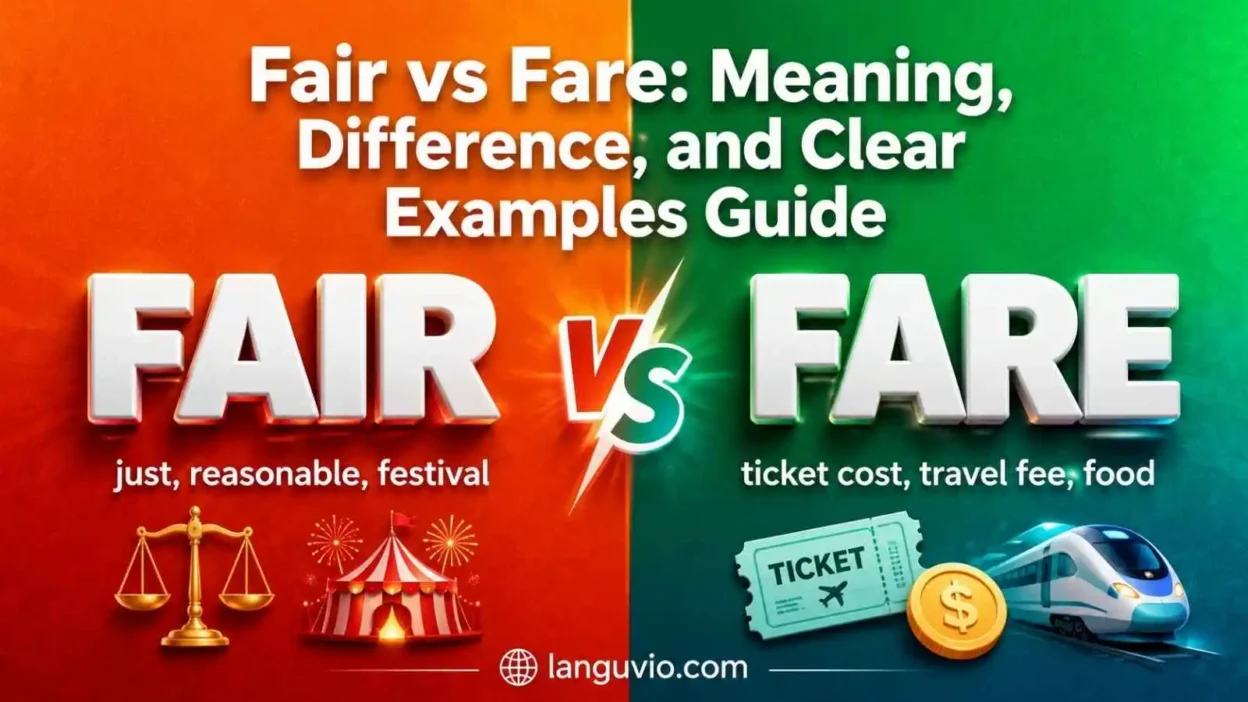
Fair and fare sound exactly the same, but they do not mean the same thing. The right choice depends on what you want to say in the sentence.
Use fair when you mean just, reasonable, light in color, acceptable, pleasant, or related to a public event. Choose fare when you mean the cost of travel, food served, entertainment offered, or how someone performs.
A “fair price” is a reasonable price. A “bus fare” is the money you pay to ride a bus. One letter changes the meaning completely.
Quick Answer
Fair vs fare is a homophone pair, which means the words sound alike but have different meanings. Fair usually means just, reasonable, light-colored, clear, or connected to an event. Fare usually means a travel charge, food, entertainment, or the verb “to do” or “to perform.” Write “fair treatment,” but “bus fare.”
Why People Confuse Them
People confuse fair and fare because they sound identical in everyday speech. When you hear the word aloud, there is no pronunciation clue to show which spelling is correct.
Another reason is that both words can be nouns. A fair can be a public event, such as a county fair, state fair, job fair, or science fair. A fare can be a travel charge, a type of food, or something offered for entertainment.
Common phrases also make the confusion stronger. Writers see “fair price,” “fair game,” “bus fare,” “airfare,” and “fare well,” and the similar sound can lead to the wrong spelling.
The best way to choose is to look at the meaning, not the sound.
Key Differences At A Glance
- Fair usually means just, reasonable, light-colored, average, clear, or related to an event.
- Fare usually means a travel cost, food, entertainment, or how someone does.
- In most sentences, fair works as an adjective.
- As a noun or verb, fare is common in travel, food, review, and performance contexts.
- Both words can be nouns, but they name different things.
A quick shortcut helps: choose fair for justice, quality, weather, color, or events. Pick fare for ride costs, food, entertainment, or performance.
Meaning and Usage Difference
Fair is most often an adjective. It describes something as honest, equal, reasonable, or acceptable.
Examples:
“That was a fair decision.”
“She paid a fair price for the used bike.”
“Everyone deserves a fair chance.”
This word can also describe weather, color, or quality.
Examples:
“Fair weather is expected this weekend.”
“He has fair hair.”
“Her work was fair, but it could improve.”
As a noun, fair means a public event with vendors, rides, exhibits, competitions, or information booths.
Examples:
“We went to the state fair.”
“Students met college reps at the school fair.”
Fare works differently. As a noun, it often means the money paid for transportation.
Examples:
“The train fare went up.”
“Do you have enough cash for the taxi fare?”
It can also mean food or entertainment offered to people.
Examples:
“The café serves simple breakfast fare.”
“Light comedy is standard summer fare.”
As a verb, fare means to do, manage, or perform.
Example:
“How did your team fare in the playoffs?”
Tone, Context, and Formality
Fair is common in daily, school, business, sports, and legal writing. It often appears when people discuss rules, treatment, value, chances, and honesty.
Natural phrases include:
“fair rules”
“fair pay”
“fair warning”
“fair competition”
Fare appears often in travel, transportation, dining, reviews, and performance writing.
Useful phrases include:
“bus fare”
“airfare”
“local fare”
“fare better next time”
Neither word is automatically formal or informal. The tone depends on the phrase. “Fair trial” sounds serious. “County fair” feels casual and community-based. “Transit fare” sounds practical. “The plan fared well” sounds more polished than “the plan did well,” but it is still normal English.
Pronunciation matters because both words sound like “fair.” Spelling must come from meaning.
Which One Should You Use?
| Context | Best Choice | Why |
| Justice or equal treatment | fair | It means honest, right, or unbiased. |
| Reasonable price or deal | fair | The price is being judged as acceptable. |
| Cost of a ride | fare | It means the charge for transportation. |
| Public event with rides or booths | fair | A fair is an event or exhibition. |
| Food served or offered | fare | It can mean food or offerings. |
| How someone performs | fare | The verb means to do or manage. |
| Clear or pleasant weather | fair | “Fair weather” means not stormy. |
| Playing by the rules | fair | “Play fair” means act honestly. |
Choose fair when the sentence describes justice, quality, weather, color, or an event. Use fare when the sentence involves travel cost, food, entertainment, or performance.
When One Choice Sounds Wrong
Some mistakes look small, but they change the sentence.
“Bus fair” sounds wrong because a bus does not usually hold a public event. The correct phrase is bus fare, meaning the price paid to ride.
“County fare” also sounds wrong if you mean the event with rides, animals, games, and food stands. The correct phrase is county fair.
“Fare treatment” is incorrect because treatment can be fair or unfair. The right phrase is fair treatment.
“Fair well” is wrong when you mean someone did well. Use fare well instead.
Example:
“The new policy fared well with customers.”
That sentence means the policy performed well or was received well. In normal writing, “faired well” is usually not the correct choice.
Common Mistakes (and Quick Fixes)
Mistake: “The subway fair is too high.”
Fix: “The subway fare is too high.”
Mistake: “That was not a fare decision.”
Fix: “That was not a fair decision.”
Mistake: “We went to the county fare.”
Fix: “We went to the county fair.”
Mistake: “How did you fair on the test?”
Fix: “How did you fare on the test?”
Mistake: “The restaurant serves great fair.”
Fix: “The restaurant serves great fare.”
Mistake: “The team faired better this season.”
Fix: “The team fared better this season.”
To fix the mistake quickly, replace the word with a simple meaning. If you mean “reasonable,” write fair. When the meaning is “cost of travel,” write fare. For “performed” or “did,” choose fare.
Everyday Examples
“I think that is a fair offer.”
“The taxi fare was higher than I expected.”
“On Saturday, we took the kids to the county fair.”
“How did your presentation fare with the client?”
“She wants a fair chance to explain what happened.”
“Classic diner fare is still popular in small towns.”
“Tomorrow should bring fair weather for the game.”
“Changing the rules now would not be fair.”
“He paid the full fare before boarding the train.”
“Early reviews say the new phone fared well.”
“Play fair, or we are ending the game.”
“Next week, the school is hosting a college fair.”
Dictionary-Style Word Details
Verb
Fair: Not commonly used as a verb in everyday US English. In specialized contexts, it can mean to smooth or shape a surface, or for weather to clear. Most everyday writers rarely need this use.
Fare: Common as a verb. It means to do, manage, get along, or perform in a situation.
Examples:
“How did the team fare?”
“She fared better than expected.”
Noun
Fair: A public event, exhibition, or gathering. It can refer to a county fair, state fair, job fair, science fair, craft fair, or book fair.
Fare: The price paid for transportation, such as bus fare, train fare, taxi fare, or airfare. It can also mean food or entertainment offered to people.
Examples:
“We bought tickets at the fair.”
“My fare was $3.50.”
“The menu features simple American fare.”
Synonyms
Fair: Closest plain alternatives include just, honest, reasonable, equal, unbiased, impartial, acceptable, clear, and light-colored. The best choice depends on the sentence.
Fare: Closest plain alternatives include charge, fee, ticket price, food, offerings, do, perform, manage, and get along.
Useful opposites:
Fair: unfair, biased, unjust, unreasonable.
Fare: There is no single clean opposite for all uses. For the verb, “fail” or “struggle” may fit in some sentences, but not every time.
Example Sentences
Fair:
“The rules were fair to both teams.”
“She made a fair point during the meeting.”
“Clear skies and fair weather helped the event.”
“Many local companies attended the job fair.”
“His fair skin burns quickly in the sun.”
Fare:
“The bus fare increased this month.”
“We split the cab fare after dinner.”
“Several restaurants now serve lighter breakfast fare.”
“How did you fare in the interview?”
“Surprisingly, the sequel fared better than the first movie.”
Word History
Fair has several older meanings connected with beauty, brightness, pleasantness, and later justice or rightness. Its noun use for an event is connected with older market and public-gathering uses.
Fare is tied to older meanings of going, traveling, or making one’s way. That background helps explain why modern fare can refer to travel cost and why the verb means to do or get along.
For everyday writing, the practical point is simple: fair usually connects to justice, quality, color, weather, or events. Fare usually connects to travel cost, food, entertainment, or performance.
Phrases Containing
Fair:
“fair chance”
“fair price”
“fair share”
“fair warning”
“fair play”
“fair game”
“fair weather”
“county fair”
“state fair”
“job fair”
Fare:
“bus fare”
“train fare”
“taxi fare”
“airfare”
“full fare”
“reduced fare”
“local fare”
“standard fare”
“fare well”
“how did it fare”
FAQs
Is it fair or fare?
Use fair when you mean just, reasonable, light-colored, clear, or related to an event. Use fare when you mean a travel charge, food, entertainment, or how someone performs.
Example:
“That was a fair decision.”
“The bus fare was too high.”
What is the main difference between fair and fare?
The main difference is meaning. Fair usually describes justice, quality, weather, color, or an event. Fare usually refers to transportation cost, food offered, or performance in a situation.
Is it bus fair or bus fare?
The correct phrase is bus fare. Fare means the money you pay for transportation.
Correct: “The bus fare is $2.50.”
Incorrect: “The bus fair is $2.50.”
Is it county fair or county fare?
The correct phrase is county fair. A fair is a public event with rides, food, games, exhibits, or competitions.
Correct: “We went to the county fair.”
Incorrect: “We went to the county fare.”
Is it fair well or fare well?
Use fare well when you mean someone did well or managed well.
Correct: “The team fared well this season.”
Incorrect: “The team faired well this season.”
Can fair be a noun?
Yes. Fair can be a noun when it means a public event or exhibition.
Examples:
“science fair”
“job fair”
“state fair”
Can fare be a verb?
Yes. Fare can be a verb meaning to do, manage, or perform.
Example:
“How did you fare in the interview?”
Are fair and fare pronounced the same?
Yes. Fair and fare are pronounced the same in standard English. They are homophones, so the spelling depends on the meaning of the sentence.
How can I remember fair vs fare?
Use this simple memory trick: fair often means “right or reasonable,” while fare often connects to “travel or performance.” If money is paid for a ride, use fare. If something is just or equal, use fair.
Conclusion
Fair and fare sound alike, but they do different jobs. Use fair for justice, reasonableness, average quality, light color, clear weather, or a public event. Choose fare for transportation cost, food, entertainment offerings, or the verb meaning to do or perform.
The easiest test is meaning. When the sentence means “right,” “reasonable,” or “an event,” fair is usually correct. If the sentence means “travel charge,” “food,” or “how something did,” fare is the better choice.
Use fair when you mean just, reasonable, light-colored, clear, or related to an event. Use fare when you mean a travel charge, food, entertainment, or how someone performs.
Example:
“That was a fair decision.”
“The bus fare was too high.”
The main difference is meaning. Fair usually describes justice, quality, weather, color, or an event. Fare usually refers to transportation cost, food offered, or performance in a situation.
The correct phrase is bus fare. Fare means the money you pay for transportation.
Correct: “The bus fare is $2.50.”
Incorrect: “The bus fair is $2.50.”
The correct phrase is county fair. A fair is a public event with rides, food, games, exhibits, or competitions.
Correct: “We went to the county fair.”
Incorrect: “We went to the county fare.”
Use fare well when you mean someone did well or managed well.
Correct: “The team fared well this season.”
Incorrect: “The team faired well this season.”
Yes. Fair can be a noun when it means a public event or exhibition.
Examples:
“science fair”
“job fair”
“state fair”
Yes. Fare can be a verb meaning to do, manage, or perform.
Example:
“How did you fare in the interview?”
Yes. Fair and fare are pronounced the same in standard English. They are homophones, so the spelling depends on the meaning of the sentence.