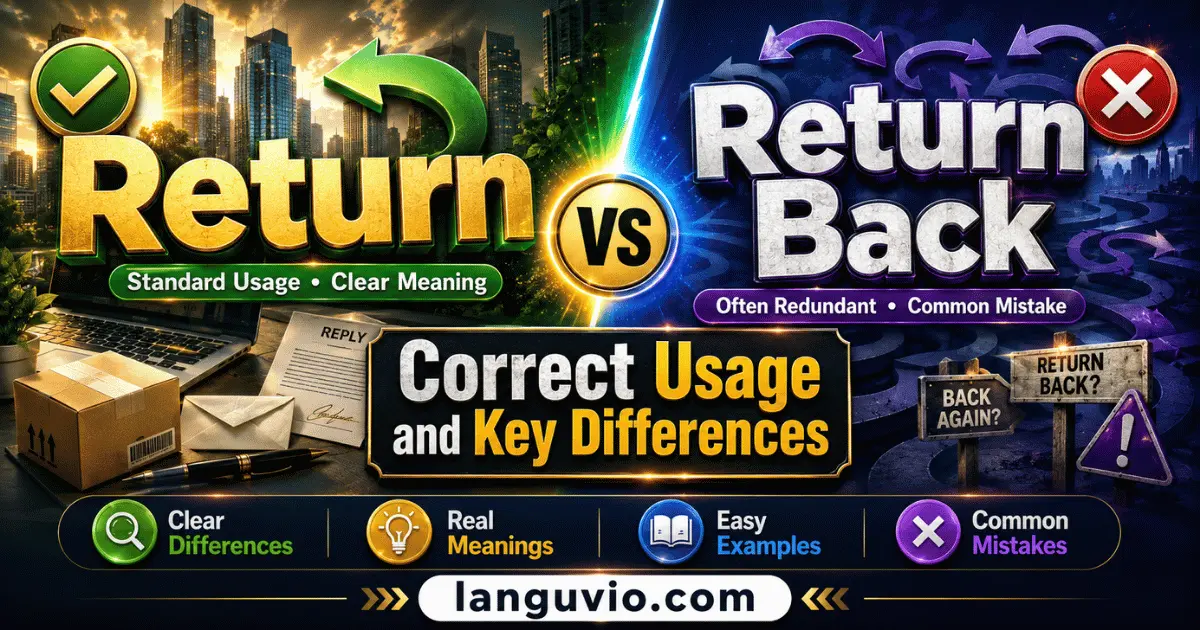
Return and return back are easy to confuse because both point to the same basic idea: going, coming, or giving something to an earlier place, person, or condition.
In standard American English, return is usually the better choice. The word already includes the idea expressed by back, so adding back normally creates unnecessary repetition.
For example:
- Preferred: “I’ll return to the office after lunch.”
- Wordy: “I’ll return back to the office after lunch.”
The second sentence is understandable. However, back does not add useful meaning. In polished speech and writing, simply use return.
Quick Answer
Use return, not return back, in most standard English sentences.
Return already means to go or come back, or to give something back. Therefore, phrases such as return back home, return back to work, and return the book back usually repeat the same idea.
Use:
- “She returned home.”
- “He returned to work.”
- “Please return the book.”
Instead of:
- “She returned back home.”
- “He returned back to work.”
- “Please return the book back.”
However, this does not mean every expression containing back is wrong. Natural alternatives include come back, go back, get back, and give it back. The problem is specifically the unnecessary pairing of return + back.
Why People Confuse Them
The confusion is understandable because English has many everyday expressions built with back.
People naturally say:
- “Come back soon.”
- “Go back to your desk.”
- “Get back home safely.”
- “Give the keys back.”
Because these expressions use back, speakers may transfer the same pattern to return and say, “return back.”
But return already carries that meaning.
Compare:
- “Come back tomorrow.”
- “Return tomorrow.”
Both can describe coming again. You need back with come to create the intended expression, but you normally do not need it with return.
The same pattern appears with objects:
- “Give the laptop back.”
- “Return the laptop.”
Both work. “Return the laptop back,” however, repeats the idea unnecessarily.
Key Differences At A Glance
- Return: An established English word that can function as a verb or noun. As a verb, it can mean to go or come to a previous place or state, or to give something to its previous owner or location.
- Return back: A combination of the verb return and the adverb back. In the usual meanings discussed here, back repeats information already expressed by return.
- Naturalness: Return is standard and concise. Return back is understandable but often sounds wordy in edited American English.
- Formality: Return works naturally in professional and formal contexts as well as ordinary conversation. Adding back does not make it more formal.
- Best practical choice: Use return alone, or choose a different natural expression such as come back, go back, or give it back when that wording better matches the situation.
Meaning and Usage Difference
The main difference is not that return and return back describe two different actions. Usually, they describe the same action, but one does so more efficiently.
Return can be used without a direct object:
“Maya returned after lunch.”
Here, returned means that Maya came or went back.
It can also be followed by a destination:
“Maya returned to the office.”
Again, the idea of going back is already present.
Return can also take a direct object:
“Maya returned the laptop.”
In this structure, it means that she gave, sent, or put the laptop back where it belonged.
Adding back usually duplicates that meaning:
“Maya returned back to the office.”
“Maya returned the laptop back.”
Both sentences can be understood, but the cleaner forms are:
“Maya returned to the office.”
“Maya returned the laptop.”
Another useful distinction involves return home. In standard usage, home can follow verbs of movement directly:
“We returned home around midnight.”
You do not need to or back:
“We returned back home around midnight.”
This is understandable, but “We returned home” is more concise.
Tone, Context, and Formality
Return is neutral and widely suitable for professional writing, customer service, schoolwork, instructions, travel, and everyday conversation.
For example:
“Employees should return to the office by 1:00 p.m.”
“Please return the signed form by Friday.”
“The system returned to normal.”
In casual conversation, Americans may prefer expressions such as come back, go back, or get back because they can sound more conversational:
“When are you coming back?”
may feel more relaxed than:
“When are you returning?”
Still, both are standard.
Return back does not create a useful formal-versus-casual distinction. It may appear naturally in spontaneous speech because people often repeat ideas while speaking. In careful writing, though, removing back usually makes the sentence tighter without changing its meaning.
Therefore:
“I’ll return to the office tomorrow.”
is better suited to polished writing than:
“I’ll return back to the office tomorrow.”
For a more conversational tone, you could instead say:
“I’ll go back to the office tomorrow.”
Which One Should You Use?
Choose return when the word itself expresses the full meaning.
Going to a previous place
Use:
“She returned to Chicago.”
Not:
“She returned back to Chicago.”
Coming to an earlier place
Use:
“He returned an hour later.”
Or, more conversationally:
“He came back an hour later.”
Giving an object to its owner or original place
Use:
“Please return my charger.”
Or:
“Please give my charger back.”
Avoid combining the two patterns:
“Please return my charger back.”
Going to a previous condition
Use:
“The neighborhood returned to normal after the storm.”
Not:
“The neighborhood returned back to normal after the storm.”
A simple rule works in most situations: If you choose the verb “return,” first try the sentence without “back.” If the meaning stays complete, leave “back” out.
When One Choice Sounds Wrong
Return back sounds especially awkward when the repeated meaning is obvious.
For example:
“Please return back the package.”
Better:
“Please return the package.”
Likewise:
“We returned back home late.”
Better:
“We returned home late.”
And:
“She returned back to her previous position.”
Better:
“She returned to her previous position.”
However, do not remove back from a different expression just because return could express a similar idea.
These are natural:
“Come back soon.”
“Go back upstairs.”
“Give the money back.”
“I’ll get back to you tomorrow.”
The important distinction is structural. Back is useful in many English expressions, but it is usually unnecessary immediately after return.
Also, avoid mechanically replacing every back expression with return. Some phrases have their own natural meanings.
For example:
“I’ll get back to you.”
is the normal expression for saying you will respond later.
“I’ll return to you.”
does not normally communicate that same idea naturally in everyday American English.
Common Mistakes (and Quick Fixes)
A common mistake is adding back because the speaker wants to emphasize movement to an earlier place.
Wordy: “I’ll return back to work Monday.”
Better: “I’ll return to work Monday.”
Another mistake appears with objects.
Wordy: “Please return back the keys.”
Better: “Please return the keys.”
With home, speakers sometimes add both unnecessary words or structures.
Wordy: “They returned back to home.”
Better: “They returned home.”
For previous conditions:
Wordy: “Everything has returned back to normal.”
Better: “Everything has returned to normal.”
Phone calls create another potential confusion.
Natural: “I’ll return your call this afternoon.”
Natural alternative: “I’ll call you back this afternoon.”
Awkward: “I’ll return back your call this afternoon.”
The fix is simple: choose one complete construction rather than combining two patterns.
Everyday Examples
| Context | Best Choice | Why |
| Workplace | “I’ll return to the office at 2:00.” | Return already expresses going back. |
| Shopping | “Please return the item within 30 days.” | Return naturally means give or take the item back. |
| Travel | “We returned home Sunday night.” | Home follows return naturally without back. |
| School | “She returned to class after lunch.” | The destination is correctly introduced with to. |
| Customer service | “I’ll return your call shortly.” | This is a standard construction for calling someone in response. |
| Previous condition | “Service returned to normal.” | Return to expresses movement to an earlier condition. |
| Casual conversation | “Come back when you have time.” | Come back is a natural conversational alternative. |
| Giving an object | “Give the jacket back to Sam.” | Give back is a natural construction separate from return. |
More examples:
“Marcus returned from Denver yesterday.”
“Please return the badge before leaving.”
“After a short break, everyone returned to the meeting.”
“The dog returned home before dark.”
“The store accepted the returned shoes.”
“I need to return this package.”
“Traffic finally returned to normal.”
“She returned to college after taking a year off.”
In each case, adding back after return would normally add words without adding useful meaning.
Dictionary-Style Word Details
Verb
Return: Commonly used as a verb. Depending on the sentence, it can mean to go or come to a previous place, state, subject, or activity, or to give, send, or put something back.
Examples:
“We returned after dinner.”
“She returned to work.”
“I returned the borrowed book.”
It can therefore be intransitive, with no direct object:
“They returned yesterday.”
Or transitive, with a direct object:
“They returned the equipment.”
Return back: Not a separate verb with a distinct dictionary meaning. It is normally the verb return followed by back. In the usual movement and restoration senses, back is redundant.
Prefer:
“He returned.”
rather than:
“He returned back.”
Noun
Return: Commonly used as a noun with several established meanings.
In the sense most relevant to this comparison, it can refer to the act of going or coming back:
“We planned our return for Sunday.”
The noun also appears in established expressions such as return trip and on your return.
Return back: Not commonly used as a standard noun phrase equivalent to the noun return.
Instead of:
“his return back home”
the more concise wording is:
“his return home.”
Synonyms
Return: The closest alternative depends on the specific meaning.
For going or coming to a previous place, closest plain alternatives include:
- come back
- go back
- get back
For giving an object to its previous owner or place:
- give back
- take back
- send back
- restore, in suitable contexts
These alternatives are not interchangeable in every sentence because perspective and context can change which one sounds natural.
Return back: Because the phrase normally expresses no separate meaning beyond return, its closest replacement is usually simply:
- return
Depending on context, a natural alternative may instead be:
- come back
- go back
- give back
- get back
A single universal antonym does not fit every sense of return. For physical movement, leave or depart may serve as an opposite in some contexts, but not when return means giving an object back or producing a result.
Example Sentences
Return:
“I’ll return to the office after my appointment.”
“Please return the library book by Tuesday.”
“They returned home before the snow started.”
“Business slowly returned to normal.”
“I missed her call, so I returned it during lunch.”
Return back:
The following sentences are understandable but normally better edited:
“I’ll return back to the office.”
Better:
“I’ll return to the office.”
“Please return the book back.”
Better:
“Please return the book.”
“They returned back home.”
Better:
“They returned home.”
Word History
Return: The word has a long-established history in English and came through French. Its historical formation is connected with the idea of turning or going back, which matches the backward or restorative meaning found in modern uses.
For present-day usage, however, the practical point is semantic rather than merely historical: modern English dictionaries already define return with meanings such as going, coming, giving, or putting back.
Return back: This is not normally treated as a separate dictionary headword with its own independent history or meaning. It is a combination of return and back, and the two often overlap in meaning.
Phrases Containing
Return:
Common and natural expressions include:
- return home
- return to work
- return to normal
- return a call
- return an item
- return trip
- return address
- in return
- on your return
Examples:
“She will return to work next week.”
“Please include a return address.”
“What did he receive in return?”
Return back:
There is no standard fixed phrase in which return back is normally required for the basic meanings discussed here.
Common redundant combinations include:
- return back home
- return back to work
- return back again
- return something back
- return back to normal
Prefer:
- return home
- return to work
- return again, when again genuinely matters
- return something
- return to normal
FAQs
“Return back” is understandable, but it is usually considered redundant in standard American English because return already includes the idea of going, coming, or giving something back. In careful writing, use return alone.
Use return home. For example, “We returned home after dinner” sounds natural and concise. Adding back repeats meaning that is already present in return.
The preferred form is return to work. Say, “She will return to work on Monday.” You could also say “go back to work” in more conversational English, but “return back to work” is unnecessarily wordy.
It is better to say return the book. The verb return already means to give or take something back. Another natural option is “give the book back,” but avoid combining both patterns.
Often, yes. Return can sound slightly more formal or polished, especially in professional writing. Come back is very natural in everyday conversation. Both are correct, but the best choice depends on tone and context.
People may use “return back” because English has many common expressions with back, such as “come back,” “go back,” and “give back.” This pattern can influence speech. The phrase is easy to understand, but in edited English, return alone is usually clearer.
If you use return, try removing back. If the sentence still has the same meaning, leave back out. For example, change “return back tomorrow” to “return tomorrow.”
Conclusion
For return vs return back, return is usually the correct and more natural choice in standard American English.
The reason is simple: return already expresses the idea of going, coming, giving, or moving something back. Adding back usually repeats meaning rather than creating a useful distinction.
Write:
“I’ll return tomorrow.”
“She returned to work.”
“Please return the package.”
“Everything returned to normal.”
Return back may appear in spontaneous conversation and is easy to understand, but careful writing normally benefits from removing the unnecessary back.
Remember that back itself is not the problem. Expressions such as come back, go back, get back, and give it back are completely natural. The key is to choose one complete construction instead of combining return with a word that usually repeats what return already means.