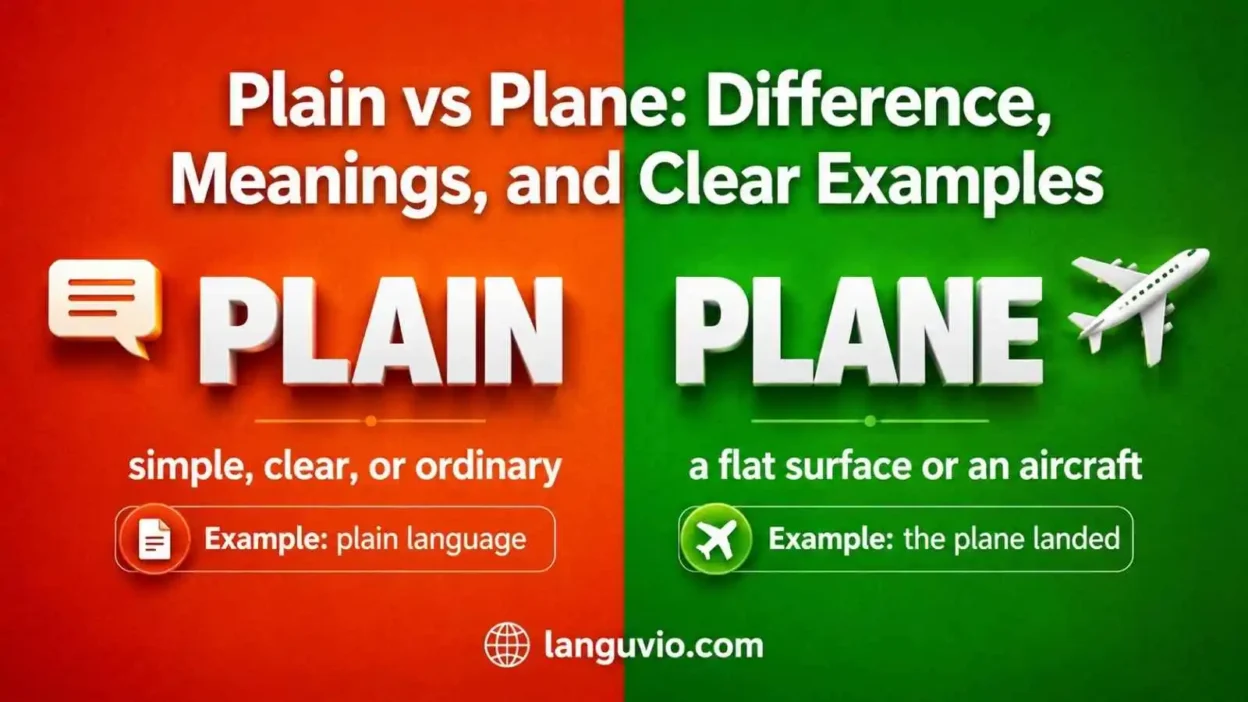
Plain vs plane is a common word-choice problem because the two words sound exactly the same in American English. The correct word depends on meaning. Use plain when you mean simple, clear, undecorated, obvious, or a flat area of land. Use plane when you mean an aircraft, a flat surface in math or design, a woodworking instrument, or the action of smoothing wood.
These words are not interchangeable. “A plain bagel” is a simple bagel. “A plane ticket” is a ticket for an aircraft. One letter changes the meaning completely.
Quick Answer
Use plain for something simple, clear, ordinary, undecorated, or easy to understand. It can also mean a broad flat area of land.
Use plane for an aircraft, a flat surface, a level of thought or existence, or a carpenter’s instrument for smoothing wood. Plane can also be a verb meaning to smooth wood or glide.
Why People Confuse Them
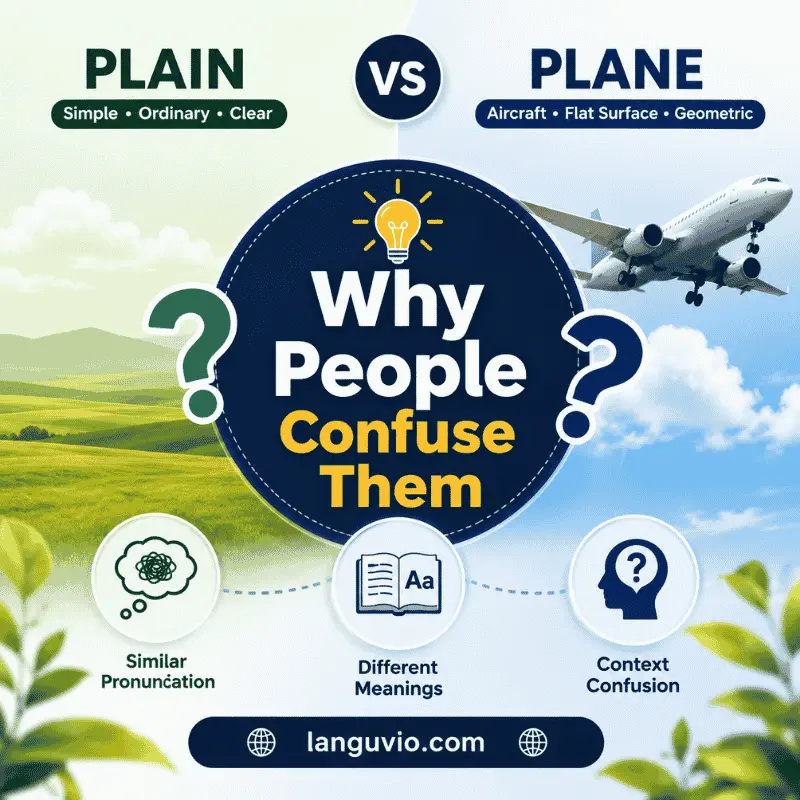
People confuse plain and plane because they are homophones. They are pronounced the same: “playn.”
The confusion gets stronger because both words can connect to flatness. A plain can be flat land. A plane can be a flat surface. That overlap makes sentences tricky when the topic is land, geometry, building, or design.
The safest method is to ask what you mean. Are you talking about simplicity or open land? Choose plain. Are you talking about flight, a flat surface, or smoothing wood? Choose plane.
Why Is It “Mortal Plane,” Not “Mortal Plain”?
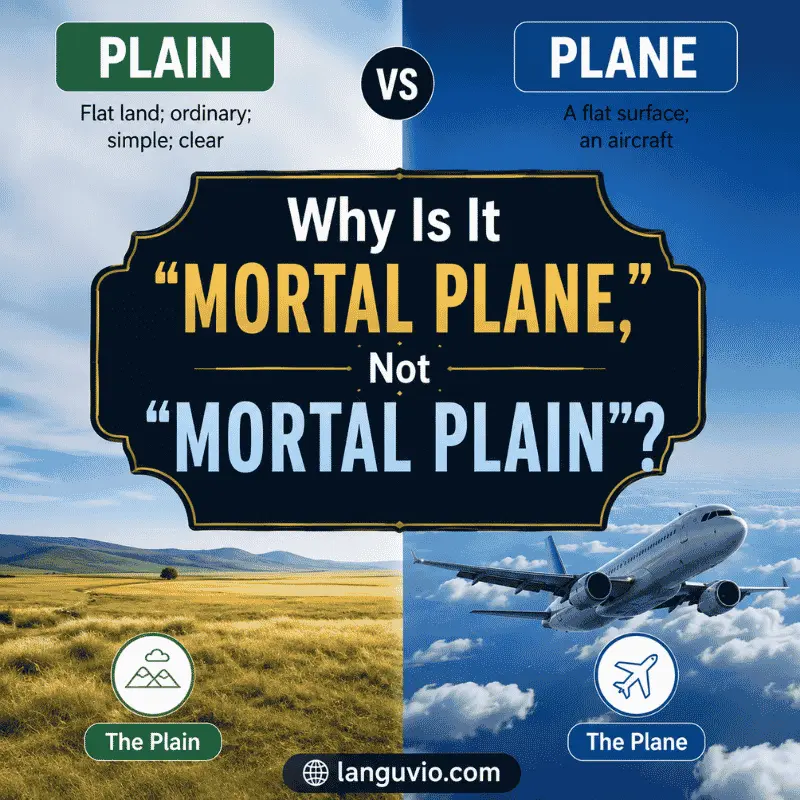
The correct expression is “mortal plane.” Here, plane means a level, realm, or state of existence.
The phrase “to leave this mortal plane” is a figurative way of saying that someone has died or left human existence.
The same meaning appears in phrases such as:
- a higher plane of thought
- another plane of existence
- the spiritual plane
Mortal plain would normally be incorrect because plain refers to something simple or undecorated, or to a broad, flat area of land.
A simple reminder is: a plain is land, while a plane can be a level of existence.
Key Differences At A Glance
| Context | Best Choice | Why |
| Simple clothing | plain | The clothing has no pattern or decoration. |
| Clear language | plain | The meaning is easy to understand. |
| Open flat land | plain | A plain is a landform. |
| Air travel | plane | A plane is an aircraft. |
| Geometry | plane | A plane is a flat surface in math. |
| Woodworking | plane | A plane smooths wood. |
| Smoothing a door | plane | The verb means to shave or smooth a surface. |
Meaning and Usage Difference
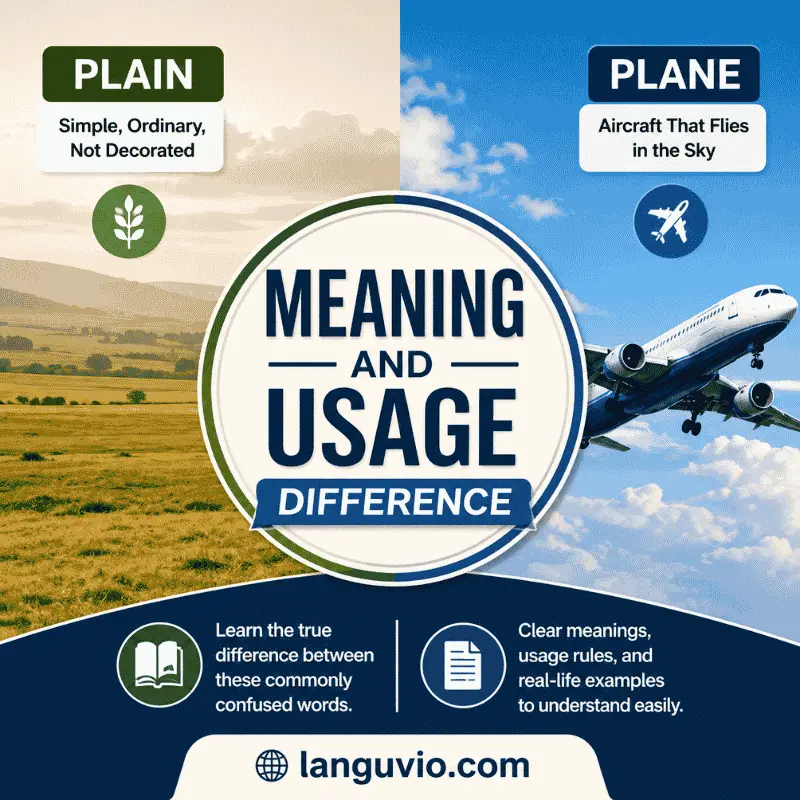
Plain is most often an adjective. It describes something simple, undecorated, clear, or ordinary.
Examples:
- She wore a plain black dress.
- Please explain it in plain English.
- The answer was plain to everyone in the room.
Plain can also be a noun. As a noun, it means a broad, flat area of land.
Example:
- The road crossed a dry plain before reaching the mountains.
Plane is most often a noun. In everyday writing, it usually means an aircraft.
Example:
- Our plane landed in Denver before noon.
Plane can also mean a flat surface, especially in math, design, or technical writing.
Example:
- The two points lie on the same plane.
It can also mean a woodworking instrument.
Example:
- He used a plane to smooth the edge of the door.
Tone, Context, and Formality
Neither word is more formal in every situation. The difference is about context.
Plain is common in everyday speech and writing. It sounds natural in phrases like plain water, plain language, plain truth, and plain old coffee. It can also sound direct or blunt when used about speech: plain talk means clear, honest talk.
Plane is also common, especially in travel. Plane ticket, plane ride, and private plane are normal in US English. In math, science, and design, plane has a more technical feel because it refers to a flat surface or level.
Pronunciation does not help you choose between them. Both words sound the same, so spelling must follow meaning.
Which One Should You Use?
Choose plain when the idea is simple, clear, bare, ordinary, or land-based.
Use plain in these cases:
- plain toast
- plain text
- plain English
- plain truth
- open plain
- coastal plain
Choose plane when the idea is flight, a flat surface, a level, or smoothing wood.
Use plane in these cases:
- plane ticket
- passenger plane
- inclined plane
- geometric plane
- wood plane
- plane the door
Compact comparison:
- Plain = simple, clear, undecorated, or flat land.
- Plane = aircraft, flat surface, level, woodworking instrument, or smoothing action.
When One Choice Sounds Wrong
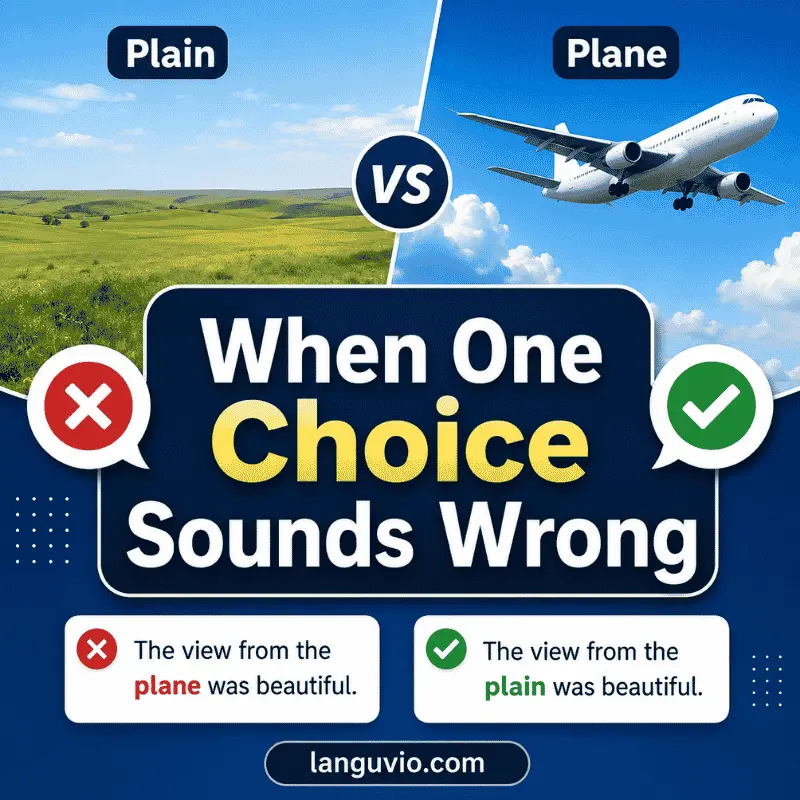
Some mistakes are easy to spot because the wrong word creates a strange image.
Wrong: I booked a plain to Chicago.
Correct: I booked a plane to Chicago.
Wrong: She ordered a plane bagel.
Correct: She ordered a plain bagel.
Wrong: The math teacher drew a line on the plain.
Correct: The math teacher drew a line on the plane.
Wrong: The hikers crossed the open plane.
Correct: The hikers crossed the open plain.
Use the sentence meaning as your guide. Food, clothing, language, and obvious facts usually need plain. Aircraft, geometry, and woodworking usually need plane.
Common Mistakes (and Quick Fixes)
Mistake: Using plain for air travel.
Fix: Use plane for aircraft.
Correct: The plane leaves at 8:30.
Mistake: Using plane for simple food.
Fix: Use plain for food with nothing added.
Correct: I ordered plain Greek yogurt.
Mistake: Using plain for a math surface.
Fix: Use plane in geometry.
Correct: The points are on the same plane.
Mistake: Using plane for open land.
Fix: Use plain for a broad flat land area.
Correct: The cattle moved across the plain.
Mistake: Thinking pronunciation will solve the choice.
Fix: Since they sound alike, choose by meaning.
Everyday Examples
I prefer plain coffee in the morning.
The instructions were written in plain English.
She bought a plain white T-shirt for the event.
The mistake was plain to see.
The family drove across a wide plain.
The plane was delayed because of bad weather.
He left his backpack on the plane.
The carpenter used a plane on the rough board.
In geometry, a plane is flat and extends in all directions.
The boat began to plane across the water.
Dictionary-Style Word Details
Verb
plain: Not commonly used as a verb in standard modern US English. Older uses meaning “to complain” exist, but everyday writers should not use plain as a verb.
plane: Common as a verb in specific contexts. It can mean to smooth or shave wood, as in “plane the door.” It can also mean to glide or skim, as in “the boat planed over the water.”
Noun
plain: A noun meaning a broad, flat area of land. Example: “The storm moved across the plain.”
plane: A noun meaning an aircraft, a flat surface, a level, or a woodworking instrument. Example: “The plane landed safely.” Example: “The board lies on a flat plane.”
Synonyms
plain: Closest plain alternatives include simple, clear, obvious, bare, ordinary, and undecorated, depending on context. For the land meaning, close alternatives include prairie, grassland, or flatland. Useful antonyms include fancy, decorated, unclear, and complicated.
plane: For aircraft, a close alternative is airplane. For the surface meaning, close alternatives include flat surface or level surface. For the verb, close alternatives include smooth, shave, or level. Exact antonyms depend on context, so a single opposite does not fit every use.
Example Sentences
plain: The room looked clean but very plain.
plain: Her meaning was plain after the second example.
plain: We watched the sun set over the open plain.
plane: The plane landed ten minutes early.
plane: The students studied points on a coordinate plane.
plane: He had to plane the cabinet door so it would close.
Word History
plain: The word is connected historically with ideas such as flatness, level ground, clarity, and simplicity. In modern use, the most helpful meanings are simple, clear, undecorated, and flat land.
plane: The word is also connected historically with flatness and level surfaces. Its modern meanings expanded into geometry, woodworking, flight, and aircraft use. For everyday readers, the main point is meaning, not origin.
Phrases Containing
plain:
- plain English
- plain truth
- plain view
- plain and simple
- plain old
- coastal plain
- flood plain
plane:
- plane ticket
- passenger plane
- private plane
- inclined plane
- coordinate plane
- plane geometry
- wood plane
FAQs
Plain refers to something simple, clear, or undecorated, or a flat area of land.
Plane refers to an aircraft, a flat surface (geometry/design), a woodworking tool, or the act of smoothing wood.
No, both are pronounced the same in American English: “playn”. Meaning determines which word to use.
Yes, plain as a noun means a broad, flat land area. Example: “The hikers walked across the grassy plain.”
Yes, plane as a verb is used in woodworking or movement. Example: “He had to plane the cabinet door to fit.” It can also mean to glide or skim over a surface.
Ask yourself what you mean:
Simplicity, clarity, or land → plain
Aircraft, flat surface, woodworking, or gliding → plane
Example: “I want a plain shirt” vs. “I booked a plane ticket.”
Conclusion
The difference between plain and plane is simple once you match the word to the meaning. Use plain for simple, clear, undecorated, obvious, or flat land. Use plane for an aircraft, a flat surface, a level, a woodworking instrument, or the action of smoothing wood. Because the words sound the same, pronunciation will not help much. Context is the real guide. A plain shirt has no decoration. A plane ticket gets you on an aircraft.