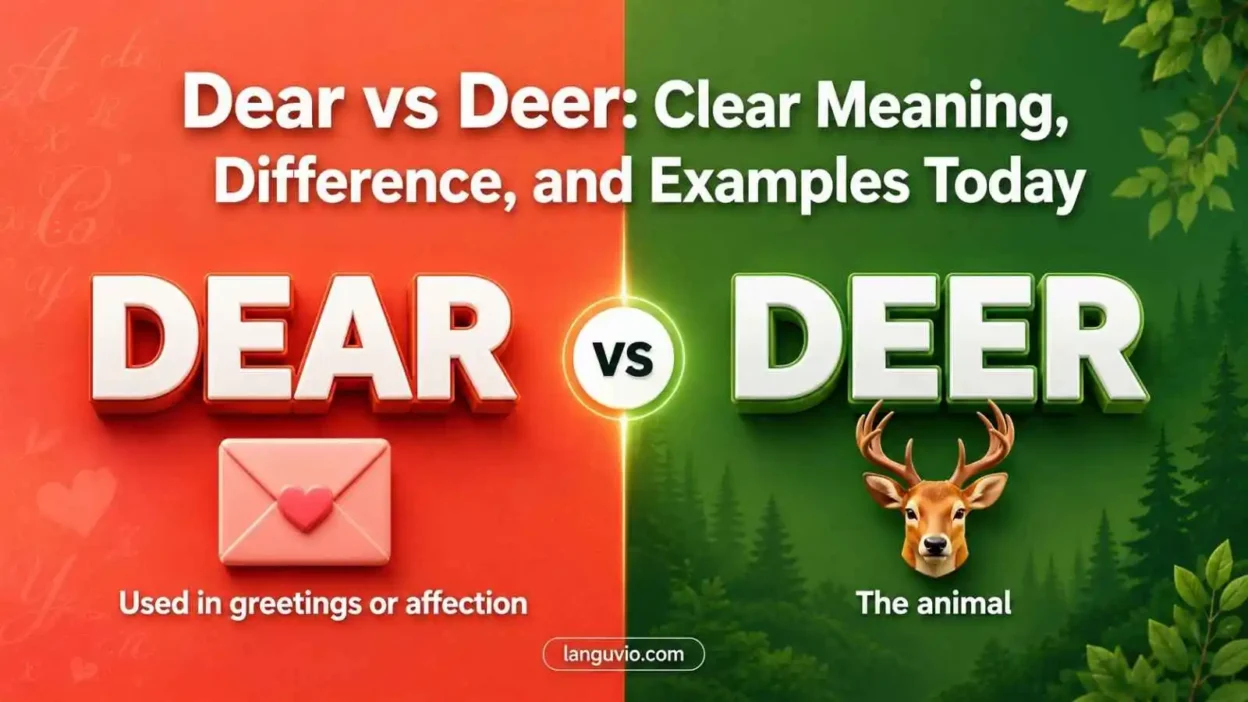
Dear vs deer is a simple word-choice problem because the two words sound the same but mean completely different things.
Use dear when you mean someone loved, valued, important, costly, or directly addressed in a greeting. Use deer when you mean the animal.
These words are not interchangeable. A dear friend is a valued friend. A deer is a wild animal. One belongs in greetings, emotions, and value. The other belongs in nature, wildlife, roads, hunting, parks, and animal descriptions.
Quick Answer
Dear means loved, valued, precious, costly, or used to address someone.
Examples:
• Dear Mom, thank you for the gift.
• Maya is a dear friend.
• That old photo is dear to me.
• Oh dear, I forgot my keys.
Deer means a hoofed animal, often with antlers in males. The plural is usually also deer.
Examples:
• A deer crossed the road.
• We saw five deer near the lake.
• The park has a large deer population.
The easiest rule is this: dear is for people, feelings, greetings, and value. Deer is for the animal.
Why People Confuse Them
People confuse dear and deer because they are homophones. That means they sound alike but have different spellings and meanings.
In standard American English, both words sound like “deer.” You cannot hear the spelling difference when someone says the word. You have to choose the spelling from the sentence meaning.
That is why this sentence works as a joke:
• My dear saw a deer.
The first word means a loved person. The second word means the animal.
Key Differences At A Glance
| Context | Best Choice | Why |
| Greeting in a letter or email | dear | It addresses the reader |
| Someone loved or valued | dear | It shows affection or importance |
| Something emotionally important | dear | It means precious or valued |
| Something costly | dear | It can mean expensive, though this is less common in everyday US speech |
| A wild animal | deer | It names the animal |
| More than one animal | deer | The plural is usually the same as the singular |
| A nature or road warning | deer | It refers to wildlife |
Meaning and Usage Difference
Dear has several common uses.
As an adjective, it can describe someone or something loved, important, or precious.
• She is a dear friend.
• This necklace is dear to me.
It can also appear at the beginning of letters and emails.
• Dear Mr. Alvarez,
• Dear Customer,
In some contexts, dear can mean expensive.
• That hotel is too dear for our budget.
This use is understood in American English, but many US speakers are more likely to say expensive in everyday conversation.
Dear can also be a noun when speaking to someone affectionately.
• Thanks, dear.
• You are such a dear.
It can also appear in the expression oh dear, which shows surprise, worry, disappointment, or mild distress.
Deer is much narrower. It is a noun for the animal.
• A deer stood at the edge of the woods.
• Several deer ran across the field.
The plural form is usually deer, not deers.
• Correct: We saw three deer.
• Usually wrong: We saw three deers.
A phrase like different species of deer is natural. The form deers is rare and usually appears only in special or technical contexts, so most everyday writers should use deer for both one animal and many animals.
Tone, Context, and Formality
Dear changes tone depending on where you use it.
At the start of a letter or formal email, Dear sounds standard and polite.
• Dear Professor Lane,
• Dear Hiring Manager,
With family or close friends, dear sounds warm and affectionate.
• You are very dear to me.
• Good night, dear.
With strangers, dear can sometimes sound too personal, old-fashioned, or uncomfortable. For example, a cashier saying “Here you go, dear” may sound friendly to some people, but too familiar to others.
In modern US workplace messages, Hi or Hello often sounds more natural than Dear when the tone is casual.
• Hi Jordan,
• Hello Team,
Deer has no emotional or formal tone by itself. It is a neutral animal word. It fits wildlife reports, road warnings, nature writing, hunting contexts, school assignments, and everyday speech.
• Watch for deer on this road.
• The children saw a deer at the nature center.
Which One Should You Use?
Use dear when the sentence is about affection, importance, greeting, concern, or cost.
• Dear Rachel, I hope you are well.
• Grandma is very dear to us.
• Oh dear, the meeting starts in five minutes.
• That mistake could cost us dear.
Use deer when the sentence is about the animal.
• A deer walked through the backyard.
• Deer often come out near dusk.
• The driver slowed down for a deer crossing sign.
Here is a compact comparison:
| Feature | dear | deer |
| Main meaning | loved, valued, costly, or used in address | animal |
| Common grammar role | adjective, noun, interjection, address word | noun |
| Pronunciation | sounds like “deer” | sounds like “dear” |
| Plural | dears when used as a noun | usually deer |
| Common context | letters, affection, value, mild surprise | wildlife, nature, roads, animals |
When One Choice Sounds Wrong
The wrong word can make a sentence confusing or funny.
Wrong: She is my deer friend.
Correct: She is my dear friend.
Wrong: A dear crossed the road.
Correct: A deer crossed the road.
Wrong: Deer Mr. Wilson,
Correct: Dear Mr. Wilson,
Wrong: We saw six dears in the field.
Correct: We saw six deer in the field.
Wrong: That ring is deer to me.
Correct: That ring is dear to me.
When checking your sentence, ask one question: Is this about an animal? If yes, use deer. If not, you probably need dear.
Common Mistakes (and Quick Fixes)
One common mistake is using deer in a greeting.
Wrong: Deer Emily,
Correct: Dear Emily,
Another mistake is adding -s to the plural animal form.
Wrong: Four deers were eating grass.
Correct: Four deer were eating grass.
Some writers also use dear when they mean the animal because the sound is identical.
Wrong: The dear ran into the trees.
Correct: The deer ran into the trees.
A final mistake is using dear too casually with people you do not know. In a formal letter, Dear is fine. In a casual work chat, Hi may sound more natural.
Formal: Dear Ms. Brooks,
Casual: Hi Ms. Brooks,
Everyday Examples
• Dear Dad, I made dinner tonight.
• A deer stepped onto the hiking trail.
• My sister is very dear to me.
• We saw two deer behind the school.
• Oh dear, I spilled coffee on my notes.
• The cabin had a sign that said, “Watch for deer.”
• That old baseball glove is dear to him.
• A deer can move quickly when startled.
• Dear members, please review the schedule.
• Several deer were grazing near the fence.
• She called her grandson “dear” in a soft voice.
• The driver stopped when a deer crossed the road.
Dictionary-Style Word Details
Verb
• Dear: Not commonly used as a verb in standard US English. Use it as an adjective, noun, form of address, or interjection instead.
• Deer: Not used as a verb in standard US English. It is a noun.
Noun
• Dear: A loved person, a kind person, or an affectionate way to address someone.
Example: You are such a dear for helping me.
• Deer: A hoofed animal, often brownish, with antlers in many males. The plural is usually deer.
Example: One deer was near the road, and three deer were in the field.
Synonyms
• Dear: Closest plain alternatives include beloved, precious, valued, cherished, costly, and expensive. For the noun use, darling and sweetheart can fit in affectionate contexts.
Helpful opposites depend on meaning: cheap or inexpensive can oppose dear when dear means costly.
• Deer: There is no exact everyday synonym for deer. Cervid is a technical alternative. Words like buck, doe, and fawn name specific kinds or ages of deer, not exact synonyms. No clear antonym is useful.
Example Sentences
• Dear: Dear Aunt Lisa, thank you for visiting us.
• Dear: This place is dear to my family.
• Dear: Oh dear, I forgot to charge my phone.
• Dear: Be a dear and hold the door, please.
• Deer: A deer appeared at the edge of the road.
• Deer: We counted seven deer near the pond.
• Deer: The deer lifted its head and ran into the woods.
• Deer: Deer are common in many parts of the United States.
Word History
• Dear: The word comes from older English forms connected with value, cost, and importance. That history helps explain why dear can mean both loved and expensive.
• Deer: The word comes from an older word that once had a broader animal meaning. In modern English, deer now refers to the specific animal family people recognize today.
The older histories are interesting, but modern writers should treat dear and deer as separate words with separate meanings.
Phrases Containing
• Dear: dear friend, Dear Sir or Madam, my dear, oh dear, dear to my heart, near and dear, for dear life, cost someone dear.
• Deer: white-tailed deer, mule deer, deer crossing, deer park, deer herd, deer season, deer tracks, deer population.
FAQs
Dear means loved, valued, precious, costly, or used to address someone in a letter or message. Deer means the animal. For example, “She is a dear friend” uses dear, while “A deer crossed the road” uses deer.
Yes. In standard American English, dear and deer are pronounced the same. They are homophones, which means they sound alike but have different spellings and meanings.
Dear friend is correct. Dear means loved, valued, or important. Deer friend is incorrect unless you are joking about a friend who is actually a deer.
Deer crossed the road is correct because deer refers to the animal. Dear does not mean an animal.
Deer can be both singular and plural. You can say “one deer” and “five deer.” In everyday English, deers is usually not used.
Yes. Dear can mean expensive, as in “That coat is too dear for my budget.” However, in modern American English, most people usually say expensive instead.
Yes. Oh dear is correct. It is used to show mild worry, surprise, disappointment, or concern. For example: “Oh dear, I forgot my wallet.”
Remember this: dear is for feelings, greetings, and value. Deer is for the animal. A dear friend is loved; a deer lives in nature.
Examples: “Dear Grandma, thank you for the card.” “That memory is dear to me.” “A deer walked through the backyard.” “We saw three deer near the lake.”
Conclusion
The difference between dear vs deer is easy once you connect each spelling to its meaning.
Use dear for a greeting, a loved person, something valuable, something emotionally important, or mild surprise. Use deer for the animal.
A simple memory trick: dear belongs close to the heart. Deer belongs in the woods.