

Both goal and aim can name something a person, team, or organization wants to achieve. That overlap makes both words correct in many sentences.
The clearest difference is grammatical and contextual. Goal is mainly a noun and is especially common for a desired result. Aim works as both a noun and a verb. As a noun, it may emphasize purpose or directed effort. As a verb, it means to intend, try, or direct something toward a point.
Quick Answer
Use goal for a result you want to reach, especially in everyday American English: “My goal is to graduate next year.” Use aim when describing a purpose or when you need a verb: “The program’s aim is to improve access,” or “We aim to improve access.” As nouns, the words often overlap, so context and sentence structure matter more than a rigid broad-versus-specific rule.
Why People Confuse Them

People confuse these words because their noun meanings are close. A personal goal can also be called a personal aim. A company’s goal can also be described as its aim.
Many explanations try to create a strict rule by saying an aim is always broad and a goal is always specific. Real usage is more flexible. Either noun can describe a general ambition or a detailed outcome.
The stronger distinction appears in grammar. Aim is a normal verb. Goal is not normally used as a verb when you mean “intend” or “try.”
Key Differences At A Glance
- Goal: usually a noun naming a desired result, endpoint, sports score, or scoring area.
- Aim: a noun naming a purpose or intended result; also a verb meaning intend, direct, or try.
- Everyday tone: goal is especially natural for personal, school, career, fitness, and financial plans.
- Formal-purpose wording: aim often appears in descriptions of courses, studies, campaigns, policies, and projects.
The noun meanings can overlap. The verb difference cannot.
Meaning and Usage Difference
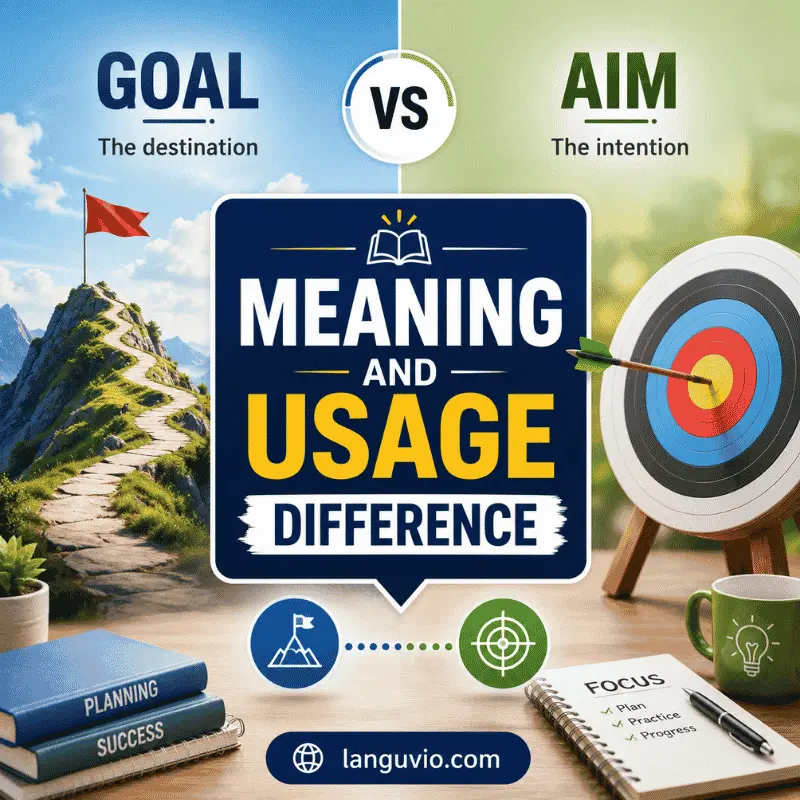
A goal is something toward which effort is directed. It often presents the result as an endpoint you hope to reach.
- Her goal is to complete the certification by December.
- Our goal is to reduce delivery delays.
- The team scored the winning goal.
An aim can also be a desired result, but it often frames the purpose behind an action, plan, or organized effort.
- The aim of the workshop is to improve writing confidence.
- Their main aim is to make the service easier to use.
As a verb, aim has two common uses. It can mean “intend or try,” as in “We aim to respond within one business day.” It can also mean “direct toward a point,” as in “He aimed the camera at the stage.”
Do not assume that every goal must be measurable or that every aim must be vague. Those may be useful distinctions inside a company or school system, but they are not universal grammar rules.
For a trusted explanation of how goal and aim overlap, see Merriam-Webster’s definition and synonym guide for “goal”
Tone, Context, and Formality
In everyday US English, goal often sounds more direct and familiar. People commonly discuss career goals, savings goals, health goals, and academic goals.
Aim as a noun can sound slightly more formal in American usage, especially when a document explains the purpose of a project, lesson, study, or campaign. However, it is not old-fashioned or unnatural.
Compare these sentences:
- My goal is to run a 10K this fall.
- The aim of the training plan is to build endurance safely.
The first sentence names the desired result. The second explains what the plan is designed to do.
As a verb, aim fits both formal and everyday sentences:
- I aim to finish before lunch.
- The policy aims to reduce unnecessary delays.
- The message was aimed at new customers.
Which One Should You Use?
Use the following table as a practical guide rather than an absolute rule.
| Context | Best Choice | Why |
| Everyday personal plan | goal | It is the most familiar noun for a desired result. |
| Project or course purpose | aim | It often introduces what the activity is designed to do. |
| A result you plan to reach | goal | It clearly emphasizes the endpoint. |
| Before “to” plus a base verb | aim | “Aim to do” is a standard verb pattern. |
| Directing a camera, object, or criticism | aim | It expresses direction toward a point or audience. |
| A score or scoring area in sports | goal | This is the established sports meaning. |
When either noun works, choose the word that matches the surrounding language. A document that already uses goals should not switch to aims without a reason.
When One Choice Sounds Wrong

Some sentences become unnatural because the writer treats goal as a regular verb.
Incorrect: We goal to improve response times.
Correct: We aim to improve response times.
Incorrect: The camera’s goal was slightly off.
Correct: The camera’s aim was slightly off.
Incorrect: She scored an aim in the final minute.
Correct: She scored a goal in the final minute.
The reverse problem also occurs. In everyday American conversation, “My fitness aim is to exercise three times a week” is grammatical, but “My fitness goal” usually sounds more natural.
Common Mistakes (and Quick Fixes)
Mistake: Treating broad versus specific as a fixed rule.
Quick fix: Decide whether the sentence emphasizes a desired result, a purpose, or a verb action. Do not force a difference that the context does not require.
Mistake: Writing “goal to do something.”
Quick fix: Use aim to, plan to, or make goal a noun: “Our goal is to finish early.”
Mistake: Mixing labels in one document.
Quick fix: Choose aims or goals for the same category and use that label consistently.
Mistake: Using aim for a sports score.
Quick fix: Use goal when a player scores or when referring to the scoring structure.
Mistake: Assuming aim is always more formal.
Quick fix: Remember that the verb aim is common in both conversation and formal writing.
Everyday Examples
- My goal is to save enough for a new laptop.
- We aim to send the revised schedule by Thursday.
- The main aim of the survey is to understand customer concerns.
- Her long-term goal is to open her own bakery.
- The class set a goal of reading six books this semester.
- This guide aims to make the difference easy to remember.
- He aimed the flashlight toward the back of the garage.
- The nonprofit’s goal is to serve more rural families.
- The campaign is aimed at first-time voters.
- Jordan scored two goals in Saturday’s game.
In many noun examples, you could replace one word with the other without making the sentence ungrammatical. The preferred choice depends on tone, common phrasing, and the meaning you want to emphasize.
Dictionary-Style Word Details
Verb
Goal: Not commonly used as a verb in everyday standard US English when the meaning is “intend” or “try.” Use “aim to,” not “goal to.” Rare sports-related verb use exists, but most writers should use score a goal instead.
Aim: Commonly used as a verb. It can mean to intend or try: “We aim to finish today.” It can also mean to direct something: “She aimed the microphone toward the speaker.”
Noun
Goal: A desired result, endpoint, sports score, or scoring area. It is a count noun: one goal, several goals.
Aim: A purpose, intended result, or the act or quality of directing something accurately. It is also a count noun in purpose-related uses: one aim, several aims.
Synonyms
Goal: Closest plain alternatives include purpose, desired result, end, ambition, and objective. In sports, its meaning is specialized, so these alternatives do not replace it.
Aim: As a noun, closest plain alternatives include purpose, intention, goal, and objective. As a verb, alternatives may include intend, try, direct, focus, or point, depending on the sentence.
Clear antonyms do not fit every meaning of either word. In some contexts, means can contrast with goal, but it is not a universal opposite.
Example Sentences
Goal: Maya reached her goal of completing the course before summer.
Goal: The organization set three goals for the next quarter.
Aim: The aim of the update is to make account settings easier to understand.
Aim: We aim to publish the results next week.
Word History
Goal: The word appeared in Middle English with a sense related to a boundary or limit. Its deeper origin is uncertain, so it is safer not to claim one definite source.
Aim: The word came into English through Anglo-French from language connected with estimating or judging. Its meaning later developed toward directing effort or attention.
Phrases Containing
Goal: reach a goal, achieve a goal, set a goal, long-term goal, career goal, common goal, with the goal of, goal setting.
Aim: aim to, aim at, aim for, be aimed at, with the aim of, take aim, main aim, ultimate aim.
Use aim to + base verb: “They aim to expand.” Use with the aim of + -ing form: “They met with the aim of finding a solution.”
FAQs
They are interchangeable in many noun phrases, especially when both mean a desired result. Still, goal sounds more natural in American conversation, while aim often fits statements about a project’s purpose. Choose according to context rather than treating them as exact matches everywhere.
A goal can be more specific, but English does not require that difference. People use both words for broad or detailed outcomes. In writing, goal often names a result you plan to reach, while aim may describe the general purpose guiding your effort.
Yes. Aim works as a verb meaning intend, try, or direct something toward a point. You can write “We aim to finish Friday” or “She aimed the camera at the stage.” Goal does not normally replace aim in either structure.
Goal is usually better for personal plans in everyday US English. Phrases such as career goal, fitness goal, and savings goal sound familiar and direct. Aim remains correct, but it may sound more formal or less conversational in a personal statement.
A project may have either, depending on the wording style. Goal highlights the result the team wants to achieve. Aim often introduces the project’s purpose, especially in formal descriptions. Keep one label consistent across the document unless a real distinction is defined.
The most common mistake is using goal as though it were a normal verb. Write “We aim to reduce delays,” not “We goal to reduce delays.” As nouns, both words can be correct, so check the sentence structure before deciding which one fits.
Conclusion
Both words are correct, and their noun meanings often overlap. Choose goal when you want the most natural everyday noun for a desired result. Choose aim when emphasizing purpose, directed effort, or the verb meaning “intend,” “try,” or “direct.”
The simplest reliable check is grammatical: you can set, pursue, or reach a goal, but you aim to do something. When both nouns fit, follow the context and keep your wording consistent.


